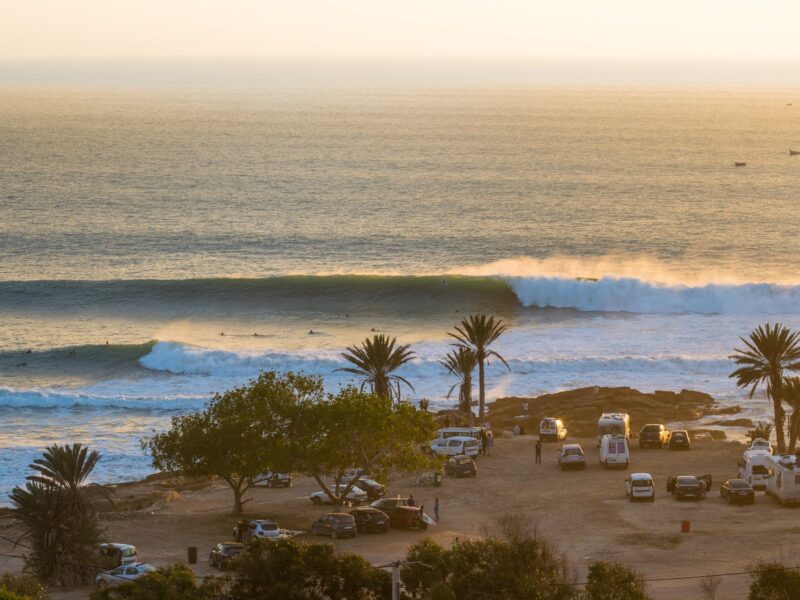
 By
By driving the Morocco coast Essaouira Imsouane Taghazout complete guide 2026 Atlantic road trip
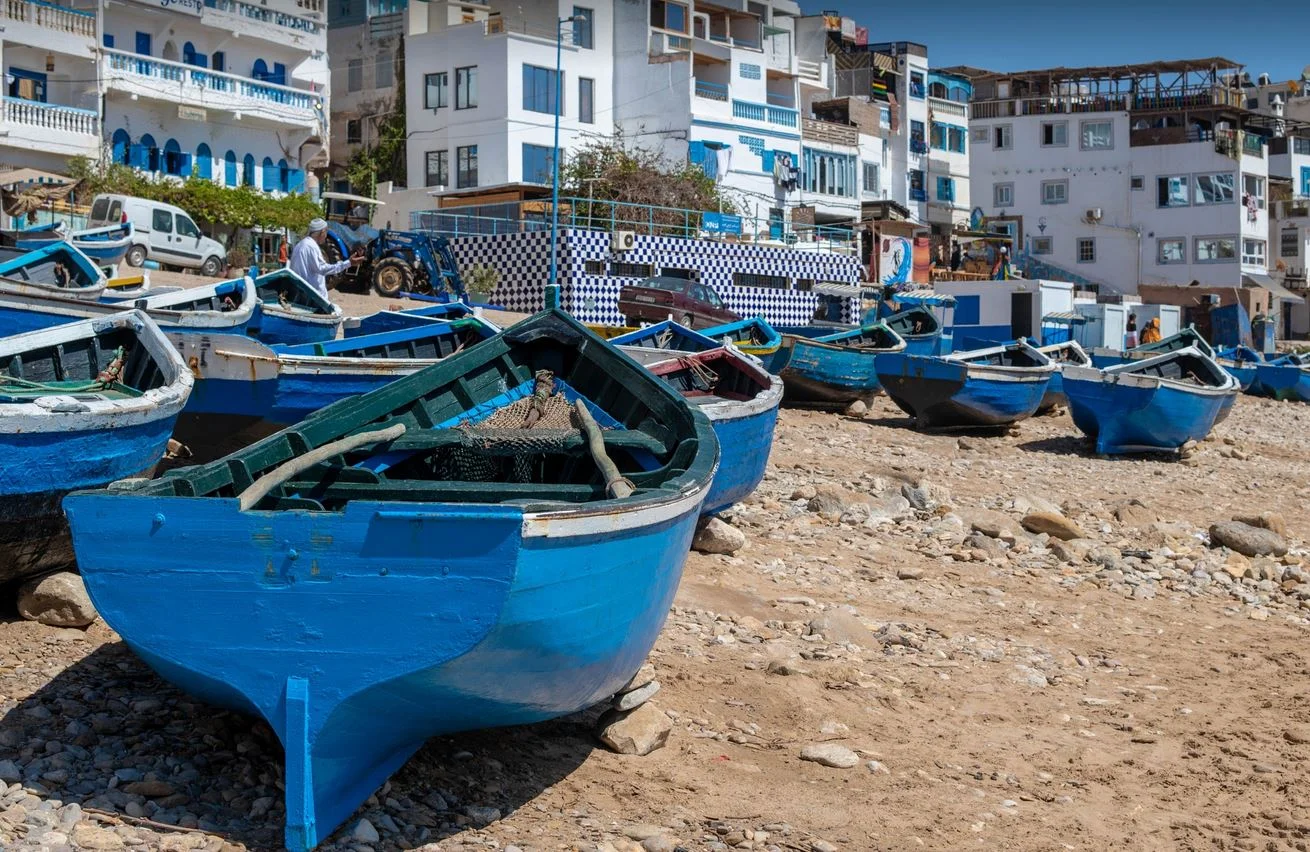
Table of Contents
- Driving the Morocco Coast: Why This Route Is So Special
- Driving the Morocco Coast: Route Overview and Distance
- Driving the Morocco Coast: Practical Road and Car Advice
- Driving the Morocco Coast: Essaouira — Where the Drive Begins
- Driving the Morocco Coast: Sidi Kaouki and the Wild Middle Section
- Driving the Morocco Coast: Imsouane — The Route’s Finest Stop
- Driving the Morocco Coast: Imsouane to Taghazout
- Driving the Morocco Coast: Taghazout — Where the Drive Ends
- Driving the Morocco Coast: Where to Eat and Stay Along the Route
- Driving the Morocco Coast: Planning the Perfect Atlantic Road Trip
Introduction
Driving the Morocco coast between Essaouira, Imsouane, and Taghazout is one of the finest road trip experiences available anywhere in North Africa — a continuous Atlantic coastal journey of approximately 200 kilometres that moves through three of Morocco’s most distinctive and most beloved surf destinations, along cliff-edge roads with ocean views that extend uninterrupted to the horizon, through argan and thuya forest that reaches almost to the cliff edge, and past fishing villages, empty beaches, and coastal landscapes of extraordinary unspoiled beauty that most of the world still does not know exist.
Driving the Morocco coast on this specific route — Essaouira south to Imsouane, then continuing south to Taghazout — is to follow the Atlantic coast road that connects three villages whose individual characters are entirely distinct but whose combined experience constitutes the most complete introduction to Morocco’s surf culture, Atlantic fishing community life, and coastal landscape available in any single continuous journey. Essaouira is UNESCO-listed, wind-swept, artistically alive, and historically layered — a walled port city whose character is shaped by the Atlantic as much as by its Moroccan identity. Imsouane is intimate, unhurried, and home to the longest right-hand wave in Africa — a fishing village that has absorbed the international surf community without losing the quiet authenticity that makes it unlike anywhere else on Morocco’s coast. Taghazout is Morocco’s most internationally recognized surf destination — a village whose surf culture has been shaped by decades of visiting surfers from Europe and beyond into a coastal experience of extraordinary energy and accessibility.
Driving the Morocco coast between these three villages delivers something that no individual destination visit can fully replicate — the sense of a coastline as a continuous, living entity rather than a series of disconnected points on a map. The road between Essaouira and Imsouane, and then between Imsouane and Taghazout, is not merely the connective tissue between destinations — it is itself part of the experience of driving the Morocco coast, delivering cliff-top Atlantic views, argan forest aromatics, roadside cafés with extraordinary ocean panoramas, and the particular quality of a coast that has been shaped by the Atlantic for millennia and has not yet been significantly altered by the tourism that is coming as Morocco’s surf culture grows.
This guide provides everything needed to drive the Morocco coast between Essaouira, Imsouane, and Taghazout in 2026 — the complete route overview, road quality and car advice, the character and essential experiences of each destination, the stops between them, the eating and sleeping options along the route, and the planning framework that makes the most of every kilometre of one of Morocco’s most rewarding road journeys.
For complete individual destination preparation alongside this driving the Morocco coast guide, read our Essaouira Morocco guide, Imsouane bay guide, travel to Morocco advice Imsouane guide, and our Morocco road trip guide — together they form the most thorough Atlantic coast road trip preparation available for any Morocco visitor in 2026.
Driving the Morocco Coast: Why This Route Is So Special
Driving the Morocco coast between Essaouira, Imsouane, and Taghazout is special for reasons that go beyond the obvious appeal of a scenic coastal road — this section explains what makes this particular stretch of Atlantic Morocco so consistently extraordinary for those who drive it.
The Road Itself — Driving the Morocco Coast Is the Experience
The coastal road between Essaouira and Taghazout via Imsouane runs closer to the Atlantic edge than almost any road of comparable length anywhere on the Moroccan coast — close enough in sections that the spray from larger swells can be seen from the car windows, and close enough that the smell of the ocean and the argan forest combined creates an olfactory experience as distinctive as anything visual along the route. Driving the Morocco coast on this road is not about getting from one surf destination to another — it is about inhabiting a coastline that is simultaneously ancient, wild, and extraordinarily beautiful in the particular way that Atlantic-facing African coasts tend to be.
Three Entirely Different Surf Villages — Driving the Morocco Coast Destination Diversity
One of the most compelling reasons for driving the Morocco coast between Essaouira, Imsouane, and Taghazout is the extraordinary diversity of character between three villages that are, on paper, all described as Moroccan Atlantic surf destinations. Essaouira is a UNESCO-listed city of 75,000 people with a centuries-old medina, a creative arts scene, an annual world music festival, and a surf and kite culture shaped by the trade winds that blow almost continuously from the north. Imsouane is a fishing village of a few hundred permanent residents whose extraordinary bay produces a wave so long and so perfect that it has drawn surfers from around the world while somehow remaining authentic to a community whose primary identity is fishing rather than surfing. Taghazout is a surf village that has grown significantly around its international reputation — more developed, more accommodating, and more internationally surf-culture-saturated than either Essaouira or Imsouane, and all the more energizing for it.
Driving the Morocco coast between these three villages in a single journey is to understand the full spectrum of what Morocco’s Atlantic coast can be — from UNESCO heritage city to intimate fishing community to internationally connected surf hub. For complete destination context, read our visit Morocco guide and Morocco travel guide.
Undiscovered Between the Destinations — Driving the Morocco Coast Hidden Stretches
Perhaps the most important reason for driving the Morocco coast between Essaouira, Imsouane, and Taghazout rather than flying or busing between these points: the coast between these villages contains stretches of entirely undiscovered, entirely undeveloped Atlantic coastline that no other form of transport accesses. The cliff sections between Sidi Kaouki and Imsouane, the unnamed beaches accessible by short tracks from the main coastal road, the wild headlands between Imsouane and Aourir — these are the driving the Morocco coast experiences that reward the visitor who takes the coastal road over every faster and more direct alternative.
Driving the Morocco Coast: Route Overview and Distance
A clear understanding of the distances, travel times, and road sequence involved in driving the Morocco coast between Essaouira, Imsouane, and Taghazout is the essential foundation of any planning for this journey.
Total Route — Driving the Morocco Coast Essaouira to Taghazout
The total driving the Morocco coast distance from Essaouira to Taghazout via Imsouane is approximately 200 kilometres: 55 kilometres from Essaouira south to the Imsouane junction (plus 7 kilometres descent into the village), and then approximately 130 kilometres from Imsouane continuing south through Aourir to Taghazout, which sits approximately 12 kilometres north of Agadir. Total non-stop driving time for the complete driving the Morocco coast route is approximately three hours and thirty minutes — but driving the Morocco coast on this route without stopping would be an act of extraordinary self-denial given the scenery, the villages, and the surf that the road continuously offers.
The Three Road Sections — Driving the Morocco Coast Sequence
Driving the Morocco coast on this route moves through three distinct road sections: the P2020 coastal road from Essaouira south to the Imsouane junction (55 km, excellent condition, cliff-edge views throughout); the descent road from the junction into Imsouane village (7 km, single-lane, well-maintained); and the coastal road from Imsouane south through Aourir to Taghazout and Agadir (approximately 130 km, good quality tarmac with some rural sections between villages). All three sections of driving the Morocco coast are navigable in a standard rental car without 4WD.
Planning Duration — Driving the Morocco Coast Timeline
Driving the Morocco coast between Essaouira, Imsouane, and Taghazout deserves a minimum of three days — one in Essaouira, one and a half to two in Imsouane, and one in Taghazout — with the driving the Morocco coast road between each destination treated as a half-day experience rather than a transit connection. Visitors with more time should give Imsouane three nights and Taghazout two — both reward extended stays more than abbreviated ones. For complete timing guidance, read our best time to visit Morocco guide.
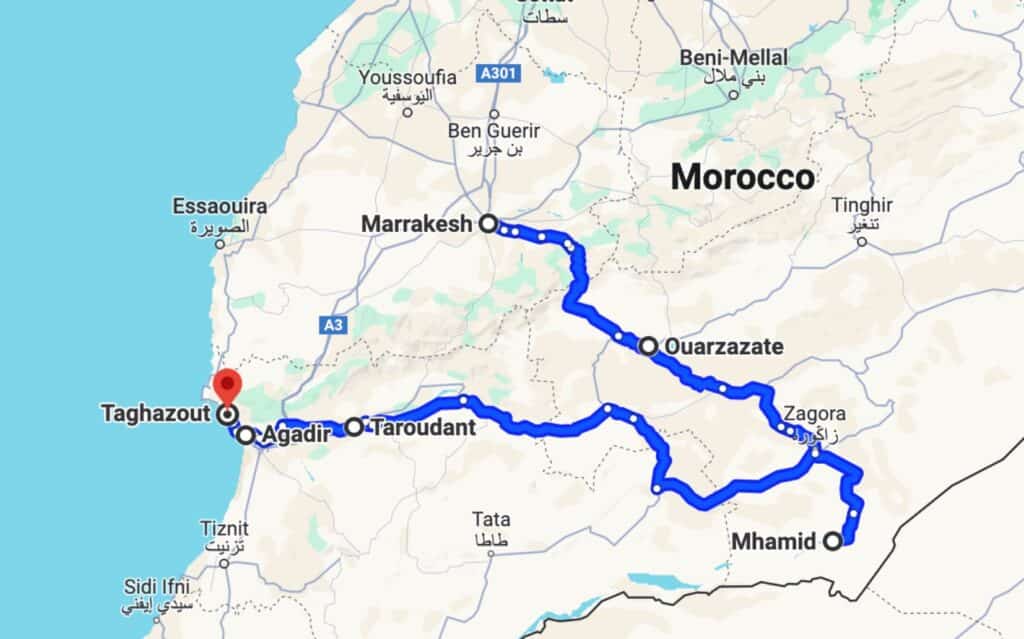
driving the Morocco coast route overview distance Essaouira Imsouane Taghazout map 2026
Driving the Morocco Coast: Practical Road and Car Advice
The practical advice for driving the Morocco coast between Essaouira, Imsouane, and Taghazout covers the vehicle, navigation, fuel, and road condition specifics that every visitor needs before setting out.
Car Rental for Driving the Morocco Coast
A standard small or medium rental car is entirely adequate for driving the Morocco coast between Essaouira, Imsouane, and Taghazout — no 4WD is required and the coastal road’s surface quality does not demand any elevated ground clearance. Car rental is available in Marrakech (the most common pickup point for Atlantic coast road trips), Essaouira (local agencies near the medina), and Agadir (for visitors flying into Agadir Al Massira Airport and driving the Morocco coast northward). One-way rental between Marrakech or Essaouira and Agadir is available from most major operators — verify drop-off fees before booking as these vary significantly. For complete road trip planning context, read our Morocco road trip guide and our route from Marrakech to Imsouane via the coast guide.
Fuel for Driving the Morocco Coast
The critical fuel driving the Morocco coast advice: fill the tank in Essaouira before departing south — there is no fuel station on the 55-kilometre coastal road between Essaouira and Imsouane. Fill again in the Imsouane area (the nearest fuel station to the village is on the main coastal road at the junction, or in the town of Smimou approximately 20 kilometres inland) before continuing south toward Taghazout and Agadir, where fuel is freely available. Driving the Morocco coast without managing fuel in Essaouira before the Imsouane section is the most common avoidable difficulty on this route.
Navigation for Driving the Morocco Coast
Download offline maps before beginning driving the Morocco coast — mobile data coverage on the coastal road south of Essaouira is inconsistent and GPS reliability without offline maps cannot be assumed in the more remote sections between Essaouira and Imsouane. The Imsouane junction turnoff is easy to miss at speed — save the GPS coordinates of Imsouane village specifically as a waypoint before leaving Essaouira. Google Maps offline and Maps.me both navigate the driving the Morocco coast route adequately. A local Moroccan SIM card provides data backup where coverage exists — purchase at Agadir airport or in Essaouira before the drive.
Cash for Driving the Morocco Coast
The cash driving the Morocco coast advice: withdraw sufficient Moroccan Dirhams in Essaouira before beginning the southern section of the drive — Imsouane has no ATM in the village, and the coastal road between Essaouira and Taghazout has no banking infrastructure. Taghazout has ATM access but arriving with sufficient cash from Essaouira removes any financial uncertainty from the driving the Morocco coast experience. For complete Morocco financial planning, read our Morocco travel cost and budget guide.
Driving the Morocco Coast: Essaouira — Where the Drive Begins
Essaouira is the natural starting point for driving the Morocco coast southward toward Imsouane and Taghazout — a UNESCO-listed walled Atlantic port city whose extraordinary character makes it the finest possible launch point for any Atlantic coast road journey.
What Makes Essaouira the Perfect Driving the Morocco Coast Start
Driving the Morocco coast southward from Essaouira begins from a city whose identity is shaped by the Atlantic as profoundly as any urban environment on Morocco’s entire coastline. The trade winds that blow almost continuously from the north have defined Essaouira’s character for centuries — cooling the city through even the hottest Moroccan summers, filling the sails of the fishing fleet that still works the waters offshore, driving the kite and windsurfing culture that has added an international surf dimension to the city’s already extraordinary identity, and creating the particular atmospheric quality — salt-wind, white walls, blue boats, blue sky — that makes Essaouira one of the most immediately visually distinctive cities in all of Morocco.
Before beginning driving the Morocco coast southward, allow at least a full day in Essaouira itself — the UNESCO medina, the sea ramparts at sunset, the port fish grill stalls, the argan cooperative in the surrounding countryside, and the beach south of the medina walls where kite surfers turn the Atlantic wind into a continuous airborne display. For everything Essaouira offers, read our Essaouira Morocco guide.
Leaving Essaouira — Driving the Morocco Coast South
The driving the Morocco coast departure from Essaouira takes the P2020 coastal road southward — not the faster inland N1 toward Agadir. The P2020 runs close to the Atlantic cliff edge almost immediately south of the city, delivering the first of the extraordinary ocean panoramas that define driving the Morocco coast on this route. Leave Essaouira in the morning — the afternoon light on the driving the Morocco coast section between Essaouira and Imsouane is extraordinary, but arriving in Imsouane with sufficient day remaining for the bay and a surf session requires a morning start from Essaouira.
Driving the Morocco Coast: Sidi Kaouki and the Wild Middle Section
The driving the Morocco coast section between Essaouira and Imsouane passes through one of the most rewarding and least-visited stretches of Atlantic coast in Morocco — a wild, cliff-edged coastal landscape punctuated by the surf village of Sidi Kaouki and several unnamed beaches accessible only by short tracks from the main road.
Sidi Kaouki — Driving the Morocco Coast First Village Stop
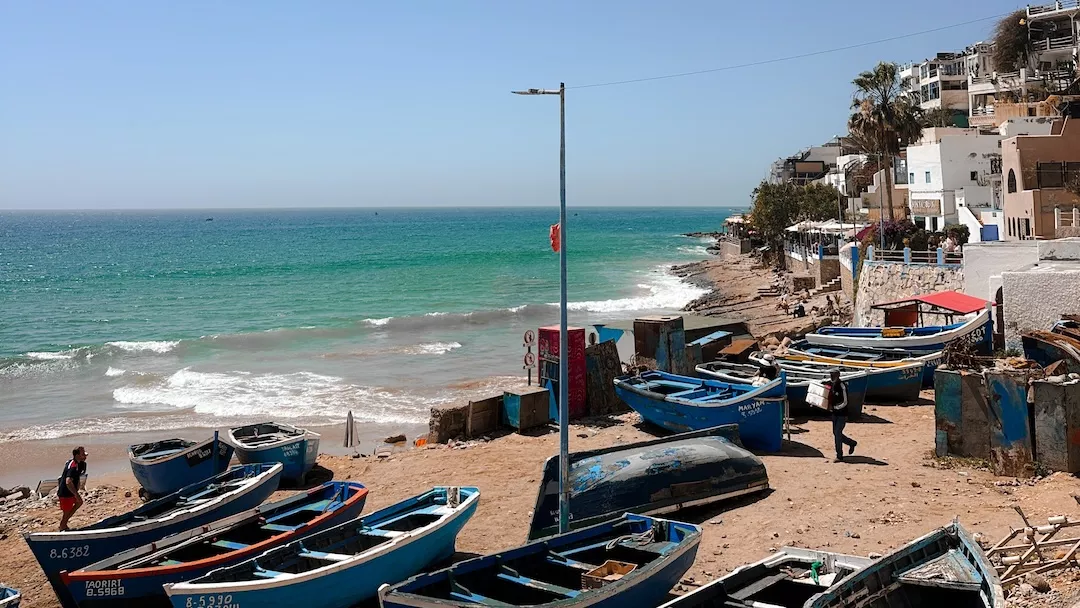
Sidi Kaouki sits approximately 25 kilometres south of Essaouira on the driving the Morocco coast coastal road — a small, windswept surf village with a long exposed beach that produces powerful Atlantic swell conditions year-round. The village has a small collection of surf camps and guesthouses, a clifftop café with extraordinary ocean views, and the atmospheric quality of a place that tourism has touched lightly — enough to provide services for visiting surfers, not enough to change its fundamental character as an Atlantic coastal community.
Stop at Sidi Kaouki on the driving the Morocco coast journey south for at least 20–30 minutes — walk to the clifftop, watch the ocean, drink mint tea at the café above the beach, and read the swell conditions that will be waiting at Imsouane and Taghazout further south. Sidi Kaouki on a good swell is a dramatic and beautiful Atlantic surf scene that provides one of driving the Morocco coast’s finest preview moments of what the southern coast has in store.
The Wild Coast Between Sidi Kaouki and Imsouane — Driving the Morocco Coast Hidden Section
The driving the Morocco coast section between Sidi Kaouki and the Imsouane junction — approximately 30 kilometres of coastal road — is the least visited and most dramatically beautiful stretch of the entire route. The road runs close to the cliff edge through argan and thuya forest, past unmarked beach access tracks that descend to entirely empty stretches of Atlantic shoreline, and through a landscape of scrubland, coastal cliff, and ocean horizon that is genuinely reminiscent of the most remote Atlantic coastlines anywhere in Europe or Africa.
Pull over safely at any viewpoint that catches attention when driving the Morocco coast on this section — the unnamed beaches accessed by rough tracks from the main road are entirely empty even in peak season and deliver the experience of a completely private Atlantic beach that is increasingly impossible to find on any more-developed coastline. These are the driving the Morocco coast moments that rewards stopping for and that no bus or organised tour accesses.
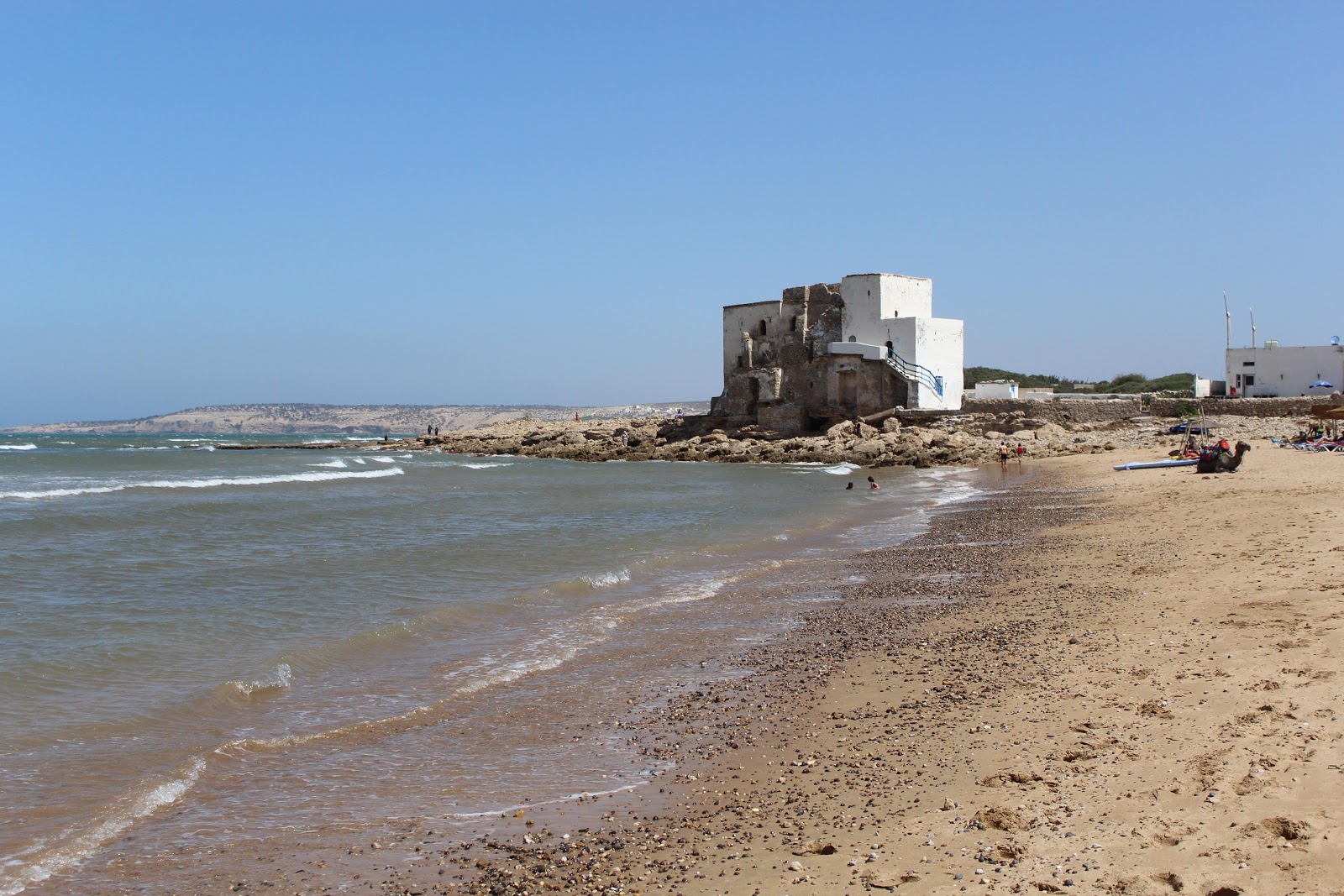
driving the Morocco coast Sidi Kaouki wild section Atlantic cliff argan forest empty beach 2026
Driving the Morocco Coast: Imsouane — The Route’s Finest Stop
Imsouane is the driving the Morocco coast route’s most extraordinary stop — a fishing village and surf destination whose combination of natural bay beauty, world-class wave, authentic community atmosphere, and extraordinary fresh fish makes it the highlight of the entire Atlantic coast journey between Essaouira and Taghazout.
Arriving at Imsouane — Driving the Morocco Coast Best First View
The driving the Morocco coast arrival at Imsouane is one of the finest first impressions of any destination on Morocco’s Atlantic coast. The junction turnoff from the coastal road descends 7 kilometres through argan scrubland on a winding single-track road before the bay appears — suddenly and completely — below the descent road. This first view of the Imsouane bay from above is one of those moments that driving the Morocco coast delivers generously and that no amount of advance photography fully prepares any visitor for. Pull over safely at the first viewpoint above the village and allow the bay to register fully before descending.
The Magic Bay — Driving the Morocco Coast Surf Highlight
The Magic Bay at Imsouane is the driving the Morocco coast route’s premier surf experience — a right-hand point break of extraordinary length and consistency that produces waves peeling for up to 800 metres from the point to the inside, making it the longest rideable right-hander in Africa. For any visitor driving the Morocco coast who surfs — at any level from complete beginner to experienced wave rider — a session at the Magic Bay is the driving the Morocco coast experience most likely to be remembered longest and most vividly. The wave is generous to beginners, endlessly engaging to intermediate surfers, and technically interesting enough to hold the attention of experienced riders seeking flow over power.
The driving the Morocco coast advice for Imsouane specifically: stay at least two nights — the village and its bay reveal themselves slowly and the single-day visitor sees only the surface of what makes Imsouane special. For the complete Imsouane guide, read our Imsouane bay guide, travel to Morocco advice Imsouane guide, and Imsouane budget travel tips guide.
Practical Imsouane Notes — Driving the Morocco Coast
The driving the Morocco coast practical notes for Imsouane: there is no ATM in the village — withdraw cash in Essaouira before the southern section of the drive. There is no fuel station in the village — fuel obtained at the junction or in Smimou before descending. Accommodation is locally owned guesthouses and surf camps costing 150–400 MAD per night. Fresh fish is the essential food experience — 50–80 MAD for a full fish plate with bread and salad at the harbour-side grills.
Driving the Morocco Coast: Imsouane to Taghazout
The driving the Morocco coast section from Imsouane south to Taghazout covers approximately 130 kilometres — a longer and more varied stretch of road than the Essaouira to Imsouane section, passing through Agadir’s urban outskirts before emerging north of the city onto the Taghazout headland.
Leaving Imsouane South — Driving the Morocco Coast Continuation
The driving the Morocco coast continuation from Imsouane southward ascends the 7-kilometre return road to the coastal junction before turning south toward Agadir. The road quality on this section of driving the Morocco coast improves as the route approaches Agadir — Morocco’s largest Atlantic resort city — and the coastal landscape becomes more populated and more developed as the distance from Imsouane increases and the gravitational pull of Agadir’s urban infrastructure becomes apparent in the roadside development.
Agadir — Driving the Morocco Coast Urban Passage
Driving the Morocco coast through Agadir’s urban area is the least scenic section of the entire route — a necessary passage through a modern Moroccan resort city of 600,000 people whose post-earthquake reconstruction in the 1960s produced an urban fabric of wide boulevards and modern buildings that bears no resemblance to the medina character of Essaouira or the village intimacy of Imsouane. Use Agadir as a practical stop when driving the Morocco coast — fill the fuel tank, withdraw cash at an ATM, and stock up on supplies — before continuing north from the city on the coast road toward Taghazout. Agadir’s beach is one of Morocco’s finest urban beaches and worth a stop if the driving the Morocco coast schedule allows. For broader city context, read our cities in Morocco guide.
Aourir and the Banana Village — Driving the Morocco Coast North of Agadir
North of Agadir on the driving the Morocco coast route, the road passes through Aourir — a coastal market town known as the Banana Village for the banana plantations that descend to the coast on its southern approach. Aourir’s Tuesday market is one of the most authentic and most colourful local markets on the entire driving the Morocco coast route — worth a stop if the timing aligns. From Aourir, the coastal road continues north approximately 12 kilometres to Taghazout.
Driving the Morocco Coast: Taghazout — Where the Drive Ends
Taghazout is the southern terminus of the driving the Morocco coast route between Essaouira, Imsouane, and Taghazout — Morocco’s most internationally recognized surf village and a destination whose energy, wave quality, and surf culture infrastructure make it the ideal conclusion to an Atlantic coast road journey.
What Taghazout Brings to Driving the Morocco Coast
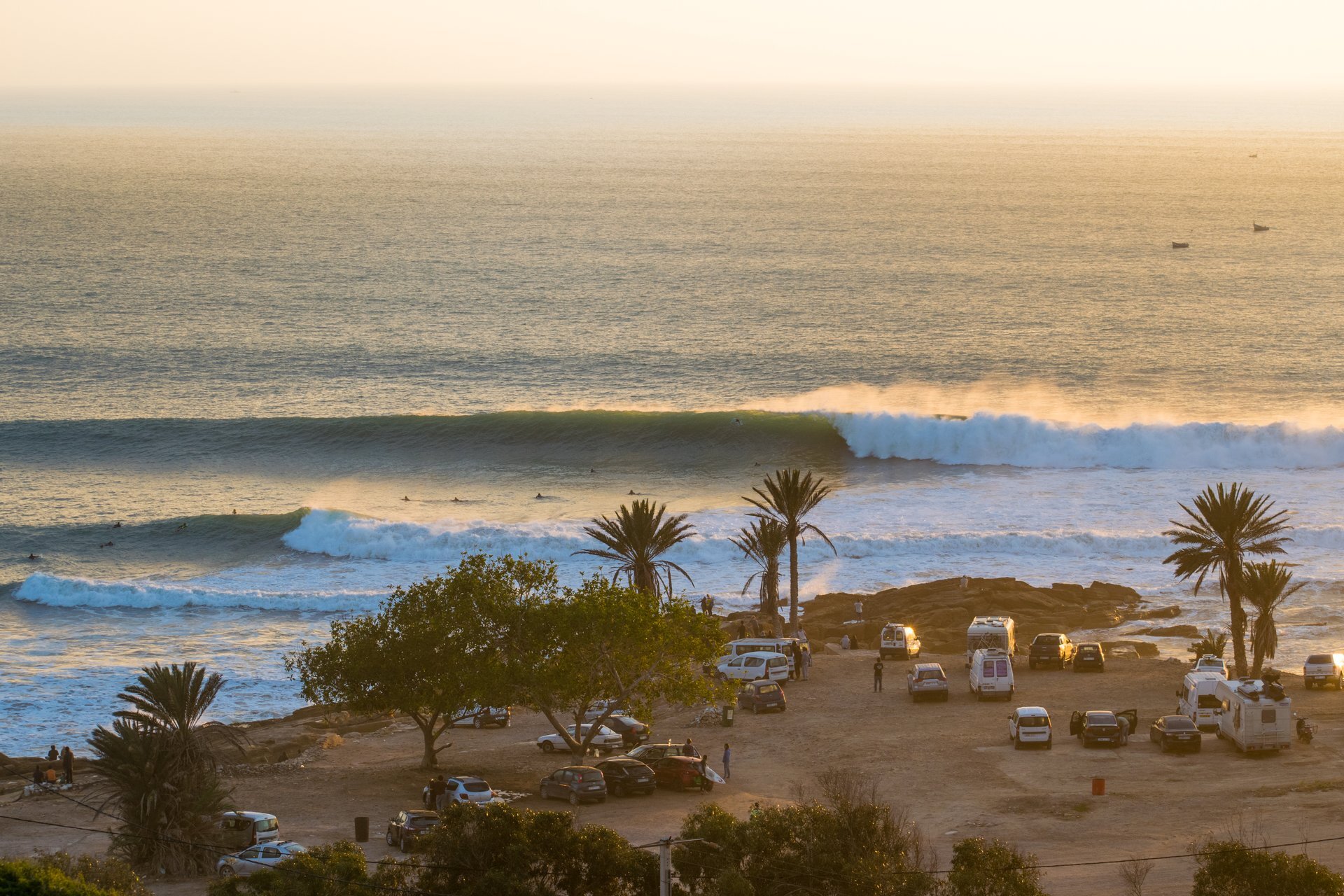
Taghazout is where driving the Morocco coast from Essaouira arrives at its most internationally developed and most surf-culturally saturated destination. The village — built on a small headland 12 kilometres north of Agadir — has been a surf destination since the 1960s and 1970s when the first travelling surfers arrived and recognized the extraordinary quality of the point breaks that ring the Taghazout headland. Hash Point, Anchor Point, Killers, and the softer inside waves of the bay itself are collectively among the finest concentration of surf breaks within walking distance of any single Moroccan village — making Taghazout the driving the Morocco coast destination that surf-focused visitors typically find hardest to leave.
Taghazout is more developed than either Essaouira or Imsouane in terms of its surf tourism infrastructure — surf camps, international cafés, board repair shops, yoga studios, and a visible international surf community give it a village energy that is simultaneously less authentically Moroccan and more immediately surf-culture accessible than the two destinations further north on the driving the Morocco coast route. Both things are true and both are part of what Taghazout offers.
Taghazout Surf Breaks — Driving the Morocco Coast Finale
The surf breaks at Taghazout — accessible on foot or by a short drive from the village — represent the driving the Morocco coast route’s final and most technically demanding surf opportunity. Anchor Point, approximately 2 kilometres north of the village, is one of the finest right-hand point breaks in Morocco — long, powerful, and consistent on a good swell, it attracts experienced surfers from across Europe and beyond and produces rides that rival any point break on the Moroccan coast. Hash Point at the village itself is more accessible to intermediate surfers. The driving the Morocco coast advice for Taghazout surf: read conditions carefully before paddling out at Anchor Point — it is significantly more powerful and more demanding than the Magic Bay at Imsouane and is not appropriate for beginners or intermediate surfers on a large swell.
driving the Morocco coast Taghazout surf village Anchor Point point break Atlantic 2026
Driving the Morocco Coast: Where to Eat and Stay Along the Route
The eating and sleeping options along the driving the Morocco coast route between Essaouira, Imsouane, and Taghazout span the full range of Morocco’s Atlantic coast hospitality — from simple locally owned guesthouses and harbour fish grills to internationally connected surf camps and boutique coastal properties.
Where to Eat — Driving the Morocco Coast Food Highlights
The driving the Morocco coast route’s essential eating experiences, in order from north to south: the port fish grill stalls in Essaouira’s harbour square — fresh grilled fish agreed by price and cooked to order at 50–100 MAD for a full plate; the clifftop café at Sidi Kaouki for mint tea and the ocean view; the harbour-side fish grills at Imsouane for the finest fresh fish on the entire driving the Morocco coast route — a full grilled fish plate with bread and salad at 50–80 MAD that regularly features in visitors’ Morocco food highlights; the banana stalls of Aourir where the freshest Moroccan bananas are sold directly from roadside vendors for virtually nothing; and the international café scene of Taghazout where a more developed food culture offers everything from traditional tagines to avocado toast and specialty coffee for the international surf community.
Where to Stay — Driving the Morocco Coast Accommodation by Destination
Essaouira accommodation for driving the Morocco coast visitors: UNESCO medina riads at 200–800 MAD per night offering the finest historic accommodation experience on the route. Imsouane accommodation: locally owned guesthouses at 150–300 MAD and surf camps at 250–500 MAD per person per night including meals. Taghazout accommodation: surf camps at 300–600 MAD per person per night, village guesthouses at 200–400 MAD, and the more developed resort accommodation of the Taghazout Bay development immediately south of the village for visitors seeking luxury driving the Morocco coast accommodation. For luxury coastal Morocco planning, read our luxury Morocco holidays guide and luxury Morocco tours guide.
Booking Driving the Morocco Coast Accommodation
The driving the Morocco coast accommodation booking advice: book Essaouira accommodation in advance for peak season visits — the medina’s best riads fill quickly during summer and the Gnaoua Festival period. Book Imsouane accommodation directly with local guesthouses by WhatsApp or email rather than through international platforms — direct booking supports the local families who run these properties and typically produces a better price. Book Taghazout accommodation in advance for winter surf season — the best surf camps fill weeks in advance during the November to February peak. For complete Morocco accommodation and budget planning, read our Morocco travel tips guide and Morocco tourism guide.
Driving the Morocco Coast: Planning the Perfect Atlantic Road Trip
This final section brings driving the Morocco coast between Essaouira, Imsouane, and Taghazout together into a complete planning framework — covering itinerary structures for different trip durations, the best season for the drive, and the practical pre-departure preparation checklist.
Three-Day Driving the Morocco Coast Itinerary
The minimum meaningful driving the Morocco coast itinerary covering Essaouira, Imsouane, and Taghazout in three days: Day one — arrive Essaouira, medina exploration, port fish lunch, rampart sunset, overnight in a medina riad. Day two — depart Essaouira 9am, Sidi Kaouki stop, arrive Imsouane by late morning, Magic Bay surf session, harbour fish lunch, clifftop café, overnight in Imsouane guesthouse. Day three — depart Imsouane mid-morning, coastal road south through Agadir, arrive Taghazout by early afternoon, afternoon surf session at Hash Point, overnight in Taghazout surf camp. This three-day driving the Morocco coast itinerary is the minimum — it delivers all three destinations but does not give any of them the depth they deserve.
Five-Day Driving the Morocco Coast Itinerary
The recommended driving the Morocco coast itinerary for visitors with five days: Day one — Essaouira arrival, medina and beach. Day two — full Essaouira day including argan cooperative excursion. Day three — depart Essaouira, coastal drive with Sidi Kaouki stop, arrive Imsouane noon, afternoon surf session. Day four — full Imsouane day — morning surf session, harbour lunch, afternoon clifftop café, village exploration. Day five — depart Imsouane, coastal road south, Aourir Banana Village market stop, arrive Taghazout, afternoon surf or beach walk. This five-day driving the Morocco coast structure gives each destination the time it genuinely deserves.
Best Season for Driving the Morocco Coast
The best season for driving the Morocco coast between Essaouira, Imsouane, and Taghazout is autumn and winter — October through February — when Atlantic swells are at their most consistent and powerful, surf conditions at all three destinations are at their finest, and the coastal road has the warm-but-not-extreme temperatures that make the driving the Morocco coast experience most comfortable. Spring is the second-best season. Summer driving the Morocco coast is possible and the coastal temperatures are moderated by Atlantic trade winds, but swell consistency drops and crowds at Taghazout and Essaouira increase significantly.
Pre-Departure Driving the Morocco Coast Checklist
Before beginning driving the Morocco coast: valid passport for all travellers with six months beyond entry date — the non-negotiable Morocco entry requirement. Comprehensive travel insurance covering driving and water sports. Rental car booked and confirmed. Sufficient Moroccan Dirham cash withdrawn before leaving Essaouira — no ATM in Imsouane. Offline maps downloaded for the full coastal route. Fuel plan in place — fill in Essaouira, refuel before Taghazout. Accommodation booked at all three destinations, particularly for peak season travel. Wetsuit and board packed or rental confirmed at each destination.
For complete Morocco entry preparation, read our Morocco travel requirements guide and Morocco travel restrictions guide. For complete Atlantic coast and Morocco-wide destination planning, read our Morocco travel guide, Morocco tours guide, Morocco things to do guide, Marrakech Morocco guide, must-visit cities in Morocco guide, and our day trip to Imsouane from Essaouira guide.
External resource: Official Morocco Tourism External resource: Windguru Surf Forecast — Morocco Coast External resource: CTM Morocco Bus Bookings
driving the Morocco coast planning itinerary checklist Essaouira Imsouane Taghazout 2026
Driving the Morocco Coast — One Road, Three Villages, One Unforgettable Journey
Driving the Morocco coast between Essaouira, Imsouane, and Taghazout is one of those travel experiences that rewrites a visitor’s understanding of what a road trip can be. It is not a journey defined by distance covered or destinations ticked — it is a journey defined by the quality of a coastline that has been shaped by the Atlantic for millennia and that reveals itself, kilometre by kilometre, as one of the most beautiful, most varied, and most quietly extraordinary stretches of ocean-facing road in the world.
Driving the Morocco coast delivers three entirely different surf villages, each with its own character, its own wave, its own community culture, and its own particular relationship with the Atlantic that shapes everything from the food to the architecture to the people’s daily rhythm. It delivers wild cliff-edge road between Essaouira and Imsouane that most visitors to Morocco never see. It delivers the first view of Imsouane’s bay from above — a moment that no photograph prepares any visitor for. It delivers fresh fish at the harbour, mint tea above the point, the smell of argan and salt air through an open car window, and the particular silence of an Atlantic coast that the surf has shaped and the argan forest has softened into something entirely its own.
Driving the Morocco coast in 2026 — in a small rental car, with offline maps downloaded and sufficient Dirhams in the glove compartment, with a wetsuit in the boot and no fixed agenda about exactly how long each village deserves — is one of the finest travel decisions any Morocco visitor can make.
Have questions about driving the Morocco coast or planning your Morocco journey? Explore our full collection of guides — including our Imsouane bay guide, Imsouane budget travel tips, travel to Morocco advice Imsouane guide, day trip to Imsouane from Essaouira guide, route from Marrakech to Imsouane via the coast guide, Essaouira Morocco guide, Morocco road trip guide, Morocco travel guide, Morocco travel tips guide, Morocco travel requirements guide, Morocco travel restrictions guide, visit Morocco guide, Marrakech Morocco guide, Morocco tourism guide, Morocco country guide, best time to visit Morocco, Morocco travel cost guide, Morocco tours guide, Morocco things to do guide, luxury Morocco holidays, luxury Morocco tours, cities in Morocco guide, and our complete must-visit cities in Morocco guide — for everything you need to drive Morocco’s Atlantic coast with total confidence in 2026.
Comments