 By
By
Marrakech Morocco Red City medina Djemaa el-Fna complete travel guide 2026
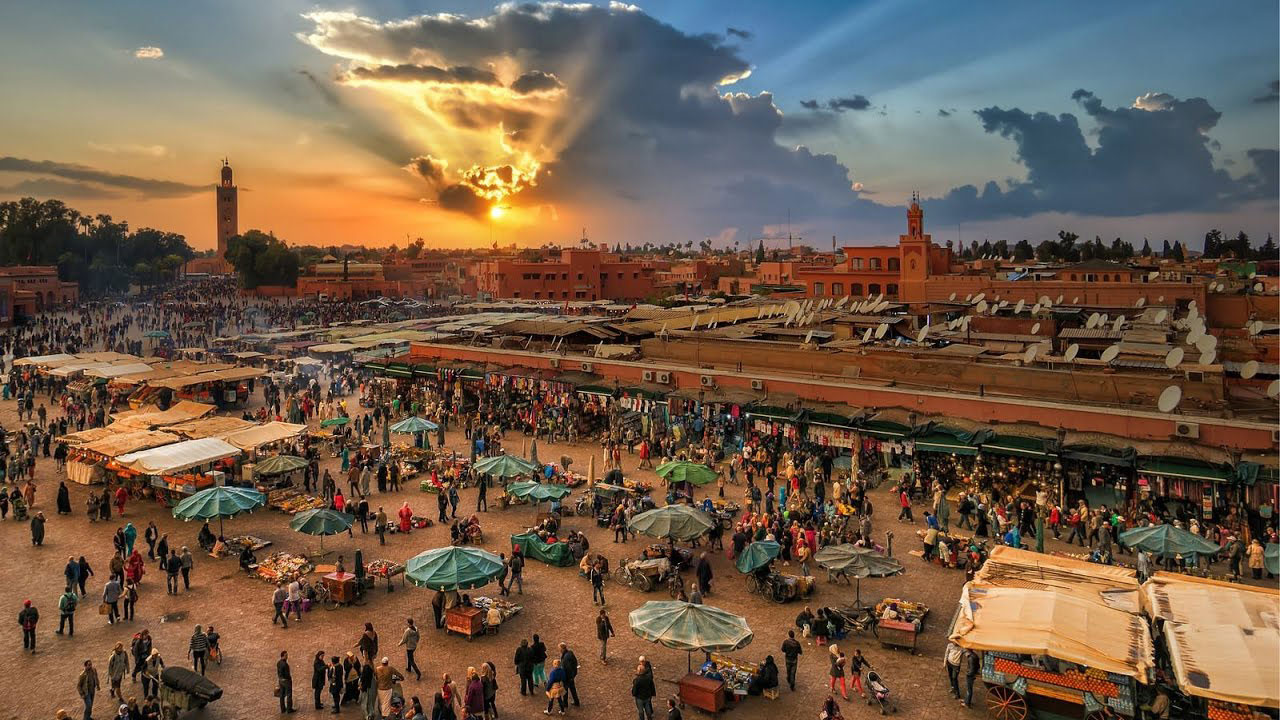
Table of Contents
- Marrakech Morocco: Why Visit the Red City
- Marrakech Morocco: Top Attractions and Must-See Sites
- Marrakech Morocco: The Best Neighborhoods to Explore
- Marrakech Morocco: Where to Stay
- Marrakech Morocco: What to Eat and Where
- Marrakech Morocco: Shopping in the Souks
- Marrakech Morocco: Best Day Trips
- Marrakech Morocco: Getting There and Around
- Marrakech Morocco: Best Time to Visit
- Marrakech Morocco: Essential Travel Tips
Marrakech Morocco is one of the most extraordinary travel destinations on earth — a city of such overwhelming sensory intensity, historical magnificence, and cultural depth that it consistently ranks among the world’s greatest urban experiences by every major travel platform and publication year after year. The Red City — named for the distinctive rose-pink hue of its ancient walls and buildings — draws millions of visitors annually from across Europe, North America, and beyond, and it rewards every single one of them with an experience that is genuinely unlike anything available anywhere else in the world.
Marrakech Morocco is a city of dramatic contrasts and constant surprises. Step through a plain wooden door in a narrow medina alleyway and find yourself in a riad courtyard of breathtaking architectural beauty — hand-painted tiles, carved cedar ceilings, and a central fountain whose sound fills the whole house. Turn a corner in the souk and encounter a craftsman hammering copper lanterns using techniques unchanged for five centuries. Walk toward Djemaa el-Fna at dusk and find yourself absorbed into one of the greatest collective human spectacles on the planet.
In 2026, Marrakech Morocco is more accessible and more visitor-ready than ever. The city’s infrastructure has been significantly improved ahead of Morocco’s 2030 FIFA World Cup preparations, with new transport links, restored heritage sites, expanded museum facilities, and a hotel and riad market that offers genuine quality across every budget level.
This guide covers everything you need to know about Marrakech Morocco — from the city’s greatest attractions and finest neighborhoods to the best accommodation, food, shopping, day trips, and the practical travel information that makes the difference between a good trip and an unforgettable one.
Before exploring Marrakech specifically, get the full picture of Morocco’s extraordinary range of destinations by reading our complete guide to things to do in Morocco — essential reading for anyone planning a broader Morocco itinerary in 2026.
Marrakech Morocco: Why Visit the Red City
The reasons to visit Marrakech Morocco are as numerous and as varied as the travellers who discover the city and immediately begin planning their return. But five qualities stand above all others in making the case for Marrakech as one of the world’s truly essential travel destinations.
A Living Medieval City
Marrakech’s medina is not a preserved museum piece — it is a living, functioning urban environment of extraordinary historical depth that has been continuously inhabited for over a thousand years. The souks that line its alleyways have been selling spices, leather, copper, and textiles since the 12th century. The craftsmen in the guild quarters still work by hand using techniques passed from father to son through generations. The mosques still call the community to prayer five times daily. The street food vendors still cook the same recipes that fed the caravans arriving from sub-Saharan Africa centuries before the first European tourist appeared.
This quality of living historical continuity — rare and rapidly disappearing in the modern world — is the most irreplaceable quality of Marrakech Morocco and the most powerful argument for visiting sooner rather than later.
Djemaa el-Fna — The World’s Greatest Square
Djemaa el-Fna is not merely a tourist attraction. It is a UNESCO Intangible Cultural Heritage — a public space of such extraordinary social, cultural, and human richness that UNESCO recognized it as an irreplaceable expression of human creativity and community. By day the square fills with orange juice vendors, henna artists, acrobats, and snake charmers. By evening it transforms into an open-air theatre of food stalls, musicians, storytellers, and magicians that has been operating continuously for centuries.
Watching the square fill at dusk from a rooftop terrace — the smoke from a hundred food stalls rising into the pink sky, the sound of Gnawa music and Berber storytelling mixing with the noise of a thousand conversations — is one of the most powerful single moments available to any traveller in Marrakech Morocco.
Architecture of Breathtaking Beauty
The architectural heritage of Marrakech Morocco — palaces, mosques, madrasas, gardens, and riads — represents one of the finest concentrated collections of Islamic and Moroccan architectural achievement anywhere in the world. The tilework of the Ben Youssef Madrasa. The garden geometry of the Saadian Tombs. The Andalusian elegance of the Bahia Palace. The soaring proportions of the Koutoubia Mosque. Each of these buildings is a masterwork of human craft and vision that rewards extended contemplation rather than a quick photograph and move on.
Food of Extraordinary Quality and Variety
Marrakech Morocco is one of the finest food cities in Africa — a place where ancient culinary traditions, abundant local ingredients, and the influence of centuries of trade and cultural exchange have produced a cuisine of extraordinary complexity and extraordinary deliciousness. From the street food of Djemaa el-Fna to the formal multi-course dinners of the great palace restaurants, eating in Marrakech Morocco is one of the most consistently rewarding aspects of visiting the city.
Gateway to Morocco’s Greatest Landscapes
Marrakech Morocco sits at the foot of the High Atlas Mountains — placing it within 90 minutes of Jebel Toubkal, North Africa’s highest peak, and within three hours of the Sahara desert road south through the Draa Valley. The city is the finest single base from which to explore Morocco’s most dramatic natural landscapes — and the contrast between the city’s urban intensity and the elemental grandeur of the Atlas and Sahara beyond makes every excursion from Marrakech feel like a revelation.
Marrakech Morocco why visit Red City medina Koutoubia mosque Djemaa el-Fna
Marrakech Morocco: Top Attractions and Must-See Sites
Marrakech Morocco’s concentration of world-class attractions in a relatively compact medina and new city makes it one of the most rewarding cities in the world for cultural sightseeing. Here are the essential attractions every visitor should prioritize.
Djemaa el-Fna Square
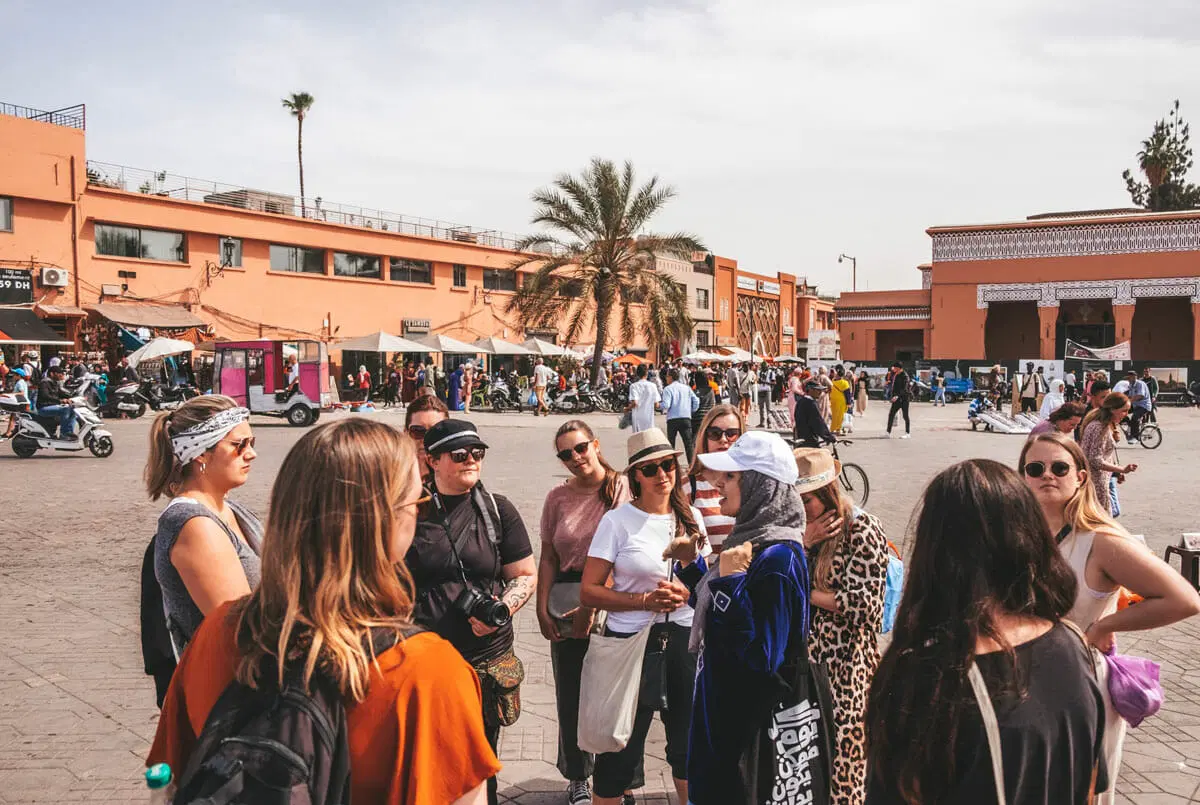
The undisputed centerpiece of Marrakech Morocco and one of the most extraordinary public spaces on earth. Visit in the morning for a quieter experience of juice vendors and locals. Return in the early evening as the food stalls assemble and the entertainers arrive. Stay for dinner at one of the numbered stall kitchens — grilled merguez sausages, harira soup, sheep’s head, and fried fish served at communal tables in the most atmospheric outdoor dining environment in Africa.
Entrance: Free Best time: 6–10pm for the full evening spectacle
Ben Youssef Madrasa
The most spectacular Islamic monument in Marrakech Morocco — a 16th-century Koranic school of breathtaking architectural refinement. The central courtyard, surrounded by galleries of intricate carved plasterwork, cedar latticework, and zellij tilework rising three storeys above a central pool, is one of the finest interior spaces in the entire Islamic world.
Entrance: 70 MAD ($7) Best time: Morning (9–11am) for the best light in the courtyard
Bahia Palace
A late 19th-century palace complex of extraordinary scale and decorative ambition — built over 14 years by the Grand Vizier Si Moussa and his son Ba Ahmed. The painted cedar ceilings, marble courtyards, and intimate garden chambers of the Bahia Palace provide one of the most complete and most accessible introductions to traditional Moroccan palatial architecture available in Marrakech Morocco.
Entrance: 70 MAD ($7) Best time: Early morning (9am opening) before tour groups arrive
Saadian Tombs
A 16th-century royal necropolis — sealed for centuries and only rediscovered in 1917 — that houses the remains of Sultan Ahmed el-Mansour and over 60 members of his court in chambers of extraordinary decorative magnificence. The central mausoleum chamber, with its carved cedar ceiling and columns of Italian Carrara marble, is one of the finest surviving interiors of the Saadian dynasty.
Entrance: 70 MAD ($7) Best time: Early morning — queues build significantly after 10am
Majorelle Garden
The most visited single attraction in Marrakech Morocco — a botanical garden of extraordinary beauty created by French artist Jacques Majorelle between 1923 and 1962, later purchased and restored by Yves Saint Laurent and Pierre Bergé. The garden’s signature cobalt blue — a specific shade registered as Majorelle Blue — applied to the garden pavilion, pots, and structures creates a visual experience of rare and arresting beauty. The YSL Museum adjacent to the garden displays the designer’s work in a beautifully conceived contemporary building.
Entrance: 150 MAD ($15) garden only. YSL Museum additional. Best time: Opening time (8am) — the garden becomes very crowded by late morning
Koutoubia Mosque
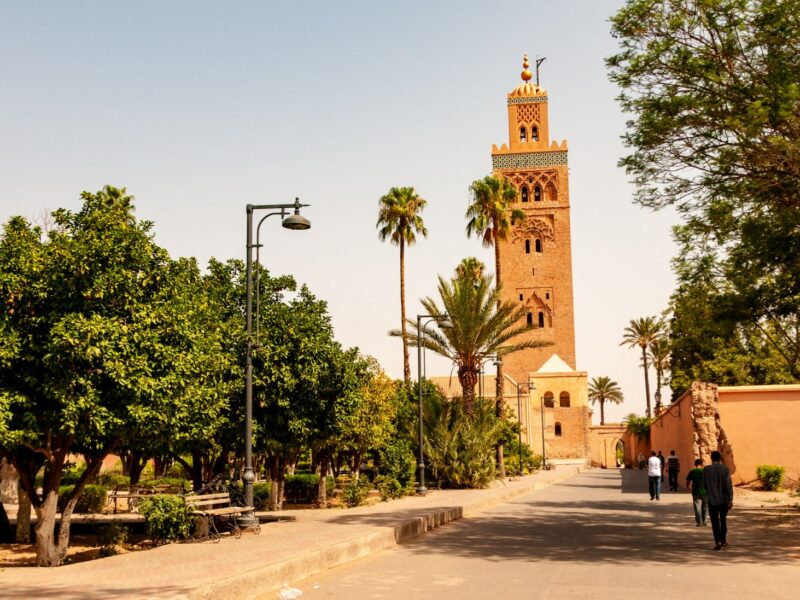
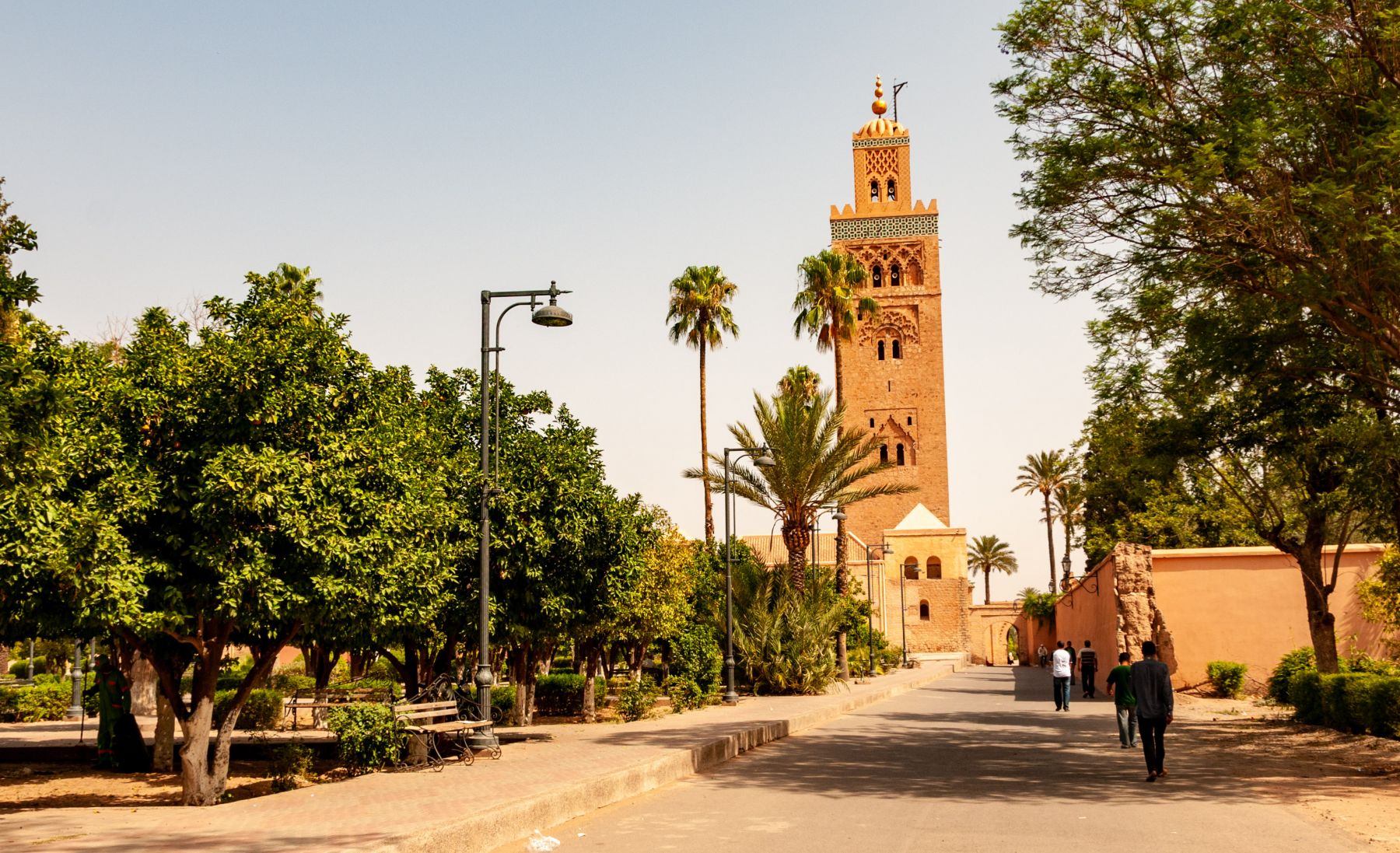
The 12th-century minaret of the Koutoubia Mosque is the defining landmark of Marrakech Morocco — a 70-metre tower of mathematical perfection and architectural refinement that has influenced Islamic architecture from Andalusia to sub-Saharan Africa. Non-Muslims may not enter the mosque but the exterior and the surrounding gardens reward extended contemplation.
Entrance: Free (exterior and gardens) Best time: Late afternoon when the minaret glows golden in the light
El Badi Palace
The ruins of what was once described as one of the most magnificent palaces in the world — a 16th-century complex of extraordinary ambition, built by Sultan Ahmed el-Mansour using materials from across the known world, stripped of its treasures to build the Meknes palaces of Moulay Ismail a century later. The vast empty courtyard, the sunken orange grove, and the rooftop terrace views across the medina make El Badi one of the most atmospheric and most photographically rewarding sites in Marrakech Morocco.
Entrance: 70 MAD ($7) Best time: Late afternoon for the best light and the most dramatic shadow play
Marrakech Morocco: The Best Neighborhoods to Explore
Understanding Marrakech Morocco’s distinct neighborhoods is essential for navigating the city intelligently and experiencing its full range of character and atmosphere.
The Medina — The Ancient Heart
The medina of Marrakech Morocco is a UNESCO World Heritage Site of approximately 14 km² — a walled medieval city divided into distinct districts that each have their own character and their own distinct section of the souk market network. The southern medina — centered on Djemaa el-Fna and the great souks — is the most visited and most tourist-facing area. The northern medina — around the Ben Youssef Madrasa and the Mouassine quarter — is less crowded and offers more authentic daily life alongside its architectural heritage.
Getting lost in the medina is not a problem — it is the experience. Follow noise, follow smell, follow light. Every wrong turn reveals something unexpected and usually extraordinary.
The Souks — Morocco’s Greatest Market
The souks of Marrakech Morocco form the commercial heart of the medina — a network of covered alleyways organized by craft and trade that has operated continuously for centuries. The spice souk (Rahba Kedima). The leather souk. The carpet souk. The copper souk. The textile souk. The jewelry souk. Each area has its own character, its own merchants, and its own particular form of negotiating theater that rewards patient engagement.
Haggling is not just expected — it is the fundamental cultural mechanism through which commercial relationships are established in the Marrakech Morocco souks. Start at roughly 50–60% of the opening price, smile consistently, and be prepared to walk away. The price that follows you out the door is almost always better than the one you were initially quoted.
Guéliz — The New City
The French-built new city of Marrakech Morocco — known as Guéliz — occupies the area west of the medina walls and provides the city’s modern commercial and cultural life. The main street, Avenue Mohammed V, is lined with cafés, restaurants, galleries, and boutiques that offer a very different experience from the medina — relaxed, spacious, and more international in character.
Guéliz is where Marrakech Morocco’s finest contemporary restaurants operate, where the city’s art galleries concentrate, and where the local professional and creative class gathers for morning coffee and evening apéritifs. Spending at least one evening in Guéliz provides essential perspective on the modern, cosmopolitan dimension of a city that is far more than its medieval core.
Hivernage — The Garden District
Hivernage is Marrakech Morocco’s most elegant residential and hotel district — a leafy quarter of broad avenues, luxury hotels, and refined restaurants immediately southwest of the medina walls. The Palais des Congrès, several of Morocco’s finest five-star hotels, and the city’s most upscale nightlife venues are located here.
Marrakech Morocco: Where to Stay
Marrakech Morocco’s accommodation market is one of the most diverse and most rewarding in North Africa — offering everything from ultra-budget hostel dormitories to some of the world’s most magnificent boutique hotels.
Staying in a Riad — The Essential Marrakech Experience
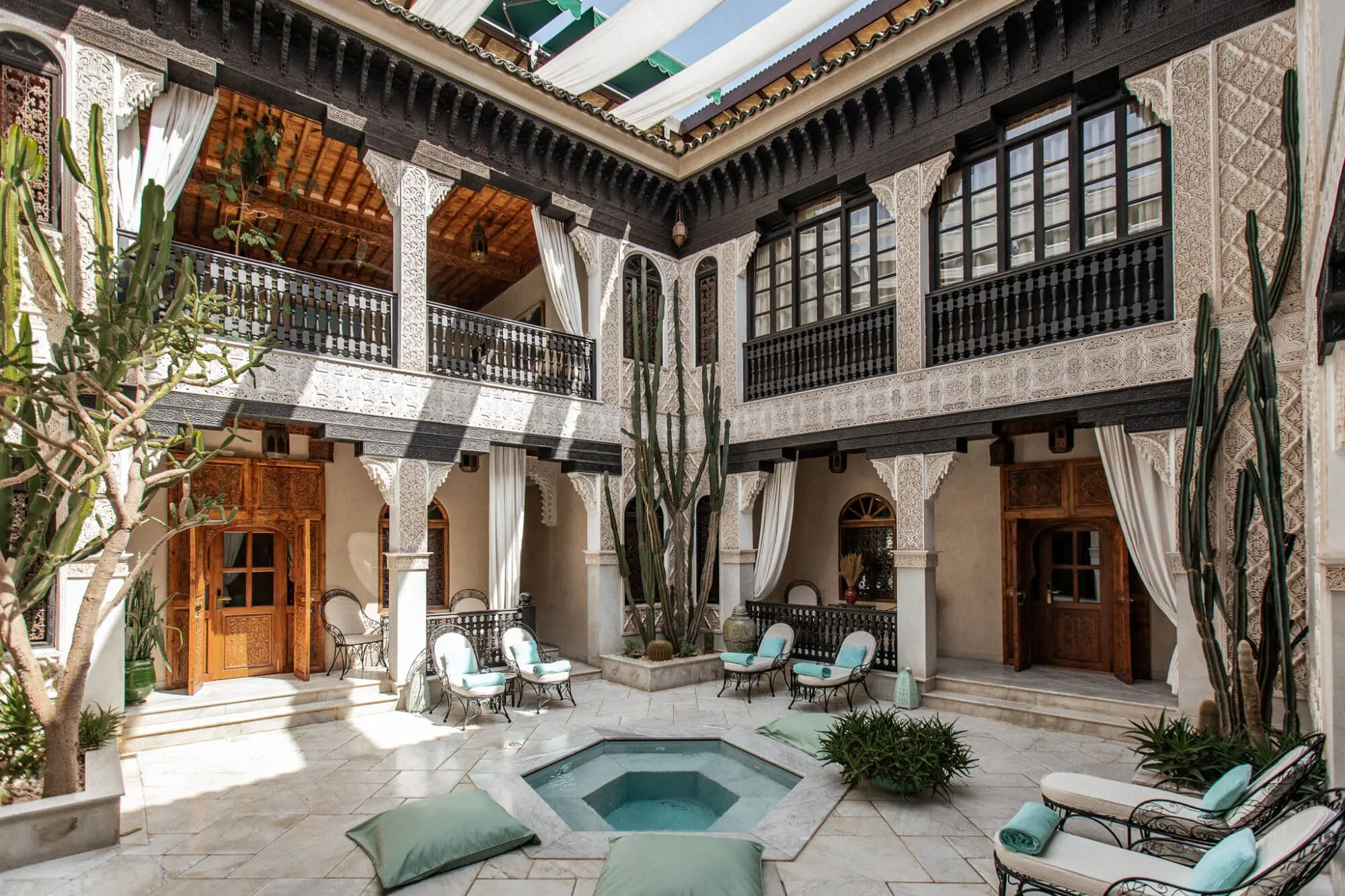
A riad — a traditional Moroccan courtyard house — is the quintessential Marrakech Morocco accommodation experience and the choice that most completely immerses visitors in the city’s architectural and cultural character. Riads range from simple family guesthouses with three or four rooms (400–800 MAD/$40–$80 per night) to palatial boutique hotels with rooftop pools, hammams, and private dining (2,000–8,000 MAD/$200–$800 per night).
The best riads in Marrakech Morocco are found in the medina — within walking distance of Djemaa el-Fna and the great souks. Book directly with the riad rather than through booking platforms — direct bookings almost always secure better rates and often include extras like free airport transfers and welcome mint tea.
Budget Accommodation
Budget travellers in Marrakech Morocco are well-served by a range of hostels, basic guesthouses, and entry-level riads in the medina and Guéliz. Dormitory beds in well-run hostels cost 100–150 MAD ($10–$15) per night. Basic private rooms in simple medina guesthouses start from 200–350 MAD ($20–$35) per night.
Luxury Riads and Hotels
Marrakech Morocco’s luxury accommodation market is among the finest in Africa — several of the world’s most celebrated boutique hotels operate within the medina walls, offering experiences of such architectural beauty and personal service that they rank as attractions in their own right. La Mamounia — the grande dame of Marrakech luxury hotels — has been welcoming kings, presidents, and celebrities since 1923 and remains one of the most iconic hotel experiences in the world.
Marrakech Morocco where to stay riad courtyard medina accommodation 2026
Marrakech Morocco: What to Eat and Where
Marrakech Morocco is one of the finest food cities in Africa — a place where the complexity and richness of Moroccan cuisine is on full and generous display across every price level from street food to palace dining.
Essential Marrakech Foods
Tagine is the defining dish of Marrakech Morocco — a slow-cooked stew of meat, vegetables, and aromatic spices prepared in the conical earthenware pot that gives it its name. Chicken tagine with preserved lemon and green olives. Lamb tagine with prunes and almonds. Kefta tagine with eggs. Each version is a distinct and deeply satisfying expression of Moroccan culinary tradition.
Couscous — the national dish of Morocco — is traditionally prepared and eaten on Fridays but available daily in Marrakech Morocco’s restaurants. The finest versions are topped with seven vegetables, slow-cooked lamb or chicken, and a rich broth that transforms simple semolina into something genuinely extraordinary.
Pastilla is Marrakech Morocco’s most sophisticated dish — a flaky warqa pastry pie filled traditionally with pigeon (or chicken) and almonds, spiced with cinnamon and dusted with powdered sugar. The combination of savory and sweet in a single pastry is the most distinctively Moroccan culinary experience available in the city.
Harira is the soul food of Marrakech Morocco — a thick, nourishing soup of tomatoes, lentils, chickpeas, and fresh herbs that is eaten to break the Ramadan fast and available throughout the day at soup stalls across the medina.
Where to Eat in Marrakech Morocco
Street food at Djemaa el-Fna — the most atmospheric and most democratic food experience in the city. The numbered stalls serve grilled meats, seafood, harira, and snails at prices that make the experience accessible to any budget.
Souk restaurants — the small, family-run restaurants tucked into the medina alleyways serve honest Moroccan home cooking at prices well below the tourist-facing establishments. Look for restaurants with Moroccan rather than international clientele — the reliable indicator of authenticity and value in any Marrakech Morocco food search.
Guéliz contemporary restaurants — the new city’s restaurant scene offers excellent modern Moroccan cuisine, international food, and wine-serving establishments in relaxed, contemporary surroundings for travellers seeking a break from medina intensity.
Marrakech Morocco: Shopping in the Souks
Shopping in the souks of Marrakech Morocco is one of the most rewarding and most culturally immersive activities the city offers — a combination of genuine craft quality, theatrical negotiation, and sensory abundance that no other shopping environment in the world can replicate.
What to Buy in Marrakech Morocco
Argan oil — both culinary and cosmetic — is the finest and most distinctively Moroccan purchase available in the city. Buy from women’s cooperatives rather than souk shops for guaranteed quality and direct benefit to producers. The argan oil culture of the Souss-Massa region — including the communities around Imsouane — is one of Morocco’s most significant cultural and economic traditions. For more on argan oil’s cultural significance in the region, read our guide to the culture and hidden gems of Imsouane Morocco.
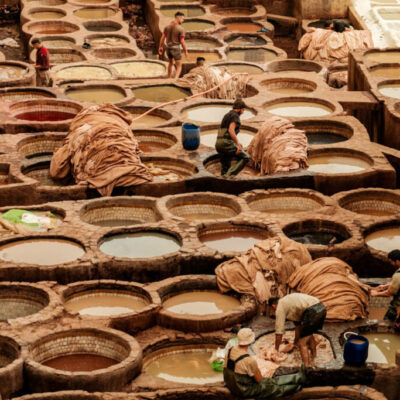
Leather goods — babouche slippers, bags, belts, and jackets — from the tanneries of Marrakech Morocco’s leather quarter represent some of the finest quality leather craft available anywhere in the world at prices that remain genuinely competitive.
Carpets and textiles — the carpet souk of Marrakech Morocco is one of the finest in the Islamic world, offering Berber rugs from the High Atlas, elaborate urban carpets from Rabat and Fès, and kilims of extraordinary design and quality.
Spices — the spice souk of Rahba Kedima sells ras el hanout (Morocco’s signature spice blend), saffron, dried rose petals, argan oil, and dozens of other culinary and medicinal ingredients that make ideal and highly portable souvenirs of Marrakech Morocco.
Haggling Strategy
Never pay the first price quoted in a Marrakech Morocco souk — ever. The opening price is a negotiating position, not a market rate. Start your counter-offer at 50–60% of the asking price, negotiate calmly and with good humor, and expect to settle at 65–75% of the original quote for most items. Walking away is a legitimate and often highly effective negotiating tactic — a significant percentage of souk vendors will call you back with a better price before you reach the end of the alley.
Marrakech Morocco: Best Day Trips
Marrakech Morocco’s position at the foot of the High Atlas Mountains and within driving distance of some of Morocco’s finest landscapes makes it one of the finest day trip bases in North Africa.
Atlas Mountains — Ourika Valley and Toubkal
The Ourika Valley — 30 km south of Marrakech Morocco — offers a refreshing contrast to city life: cool mountain air, Berber villages, saffron farms, and small waterfalls accessible by a half-day excursion. For more serious mountain engagement, the village of Imlil — 90 minutes from Marrakech — is the base for the two-day ascent of Jebel Toubkal, North Africa’s highest peak at 4,167 metres.
Essaouira — Atlantic Coast Day Trip
Essaouira, Morocco’s UNESCO-listed Atlantic walled city, is approximately 2.5 hours west of Marrakech Morocco by road — making it a long but rewarding day trip or, better, a two-day overnight excursion. The contrast between Marrakech’s medina intensity and Essaouira’s wind-battered Atlantic calm is one of the most striking in all of Morocco.
Aït Benhaddou and Ouarzazate
The UNESCO-listed kasbah of Aït Benhaddou — 190 km southeast of Marrakech Morocco over the dramatic Tizi n’Tichka mountain pass — is one of the most spectacular architectural sites in Morocco and the most popular day trip destination from the city for travellers heading toward the Sahara. Combined with a night in Ouarzazate and the beginning of the Draa Valley road south, it forms the opening chapter of the great Marrakech to Sahara road trip.
For the complete Marrakech to Sahara road trip planning guide, read our Morocco road trip guide — the most comprehensive resource available for planning any self-drive journey in Morocco.
Agadir and the Atlantic Surf Coast
A longer day trip or overnight excursion south from Marrakech Morocco over the Tizi n’Test mountain pass reaches Agadir and the extraordinary Atlantic surf coast — from Taghazout and Tamraght to the legendary bay of Imsouane. For travellers combining Marrakech with the Atlantic coast on a broader Morocco itinerary, our Imsouane bay guide and best time to visit Imsouane guide provide everything needed to plan the coastal extension of any Marrakech-based trip.
Marrakech Morocco: Getting There and Around
Flying to Marrakech Morocco
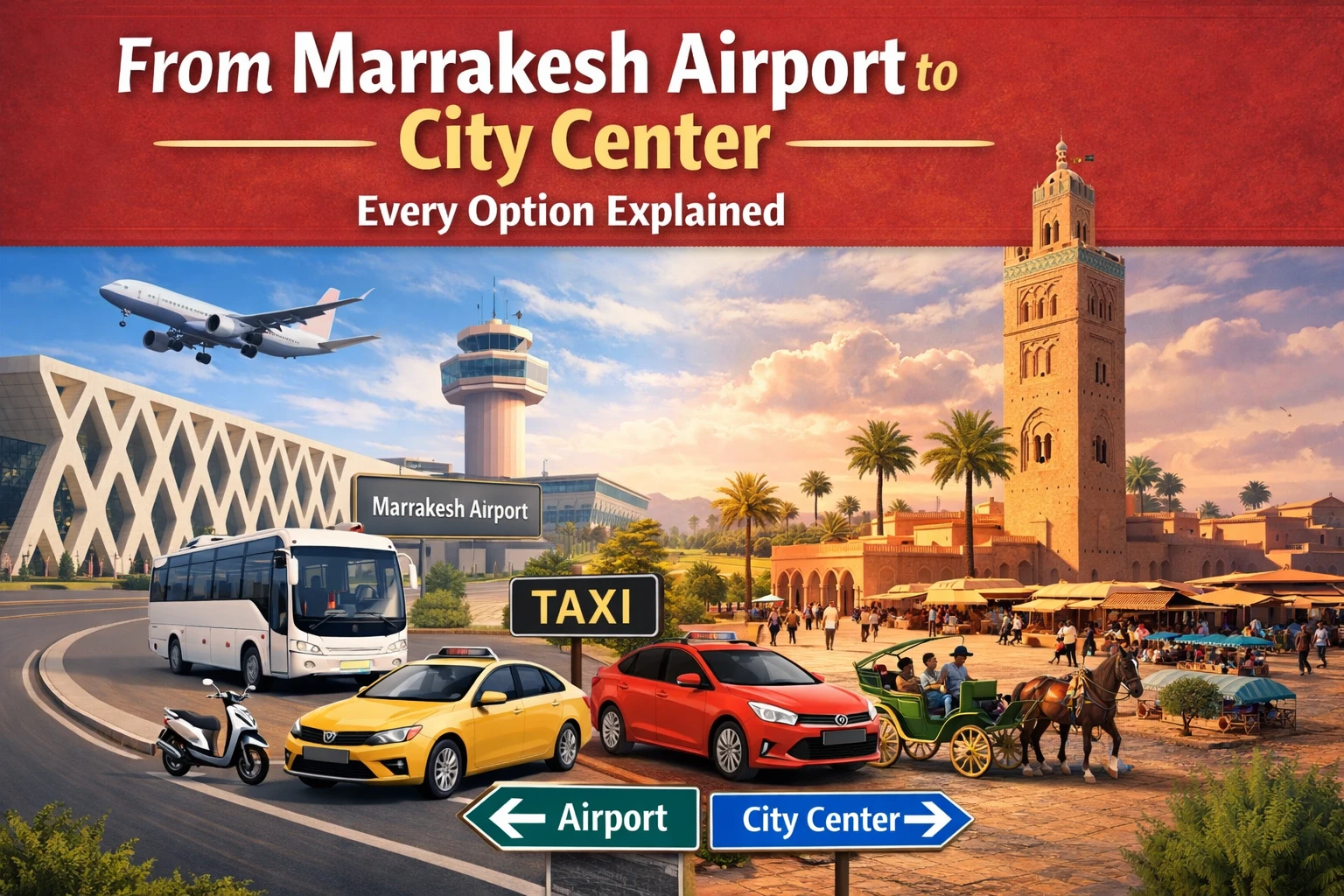
Marrakech Menara Airport is one of Morocco’s busiest and best-connected airports — served by budget airlines including Ryanair, easyJet, Transavia, and Vueling alongside Air Arabia Maroc and Royal Air Maroc with direct flights from London, Paris, Amsterdam, Madrid, Brussels, Rome, and dozens of other European cities. Fares from major European hubs start from €30–€60 one way when booked in advance.
The airport is located approximately 6 km southwest of the medina — a taxi to the medina costs 70–100 MAD ($7–$10) with a negotiated fixed fare before departure. No meter, always agree the price first.
Getting Around Marrakech Morocco
The medina of Marrakech Morocco is best explored on foot — the narrow alleyways are not accessible by car, and walking is the only way to engage with the souks, the architecture, and the street life at the pace they deserve. Comfortable walking shoes with good grip are essential — the medina’s uneven stone surfaces are demanding.
Petits taxis — small metered city taxis in Marrakech Morocco’s signature beige — are available throughout the new city and can be hailed from the medina perimeter. Always insist on the meter or agree a fixed price before departing.
Calèches — horse-drawn carriages — are a traditional and atmospheric way to travel between the medina and Guéliz. Agree the fare before boarding — typically 100–150 MAD ($10–$15) for a short journey.
Marrakech Morocco: Best Time to Visit
The best time to visit Marrakech Morocco is spring (March–May) or autumn (September–November) — the two shoulder seasons that deliver the most comfortable temperatures for medina exploration, Atlas Mountain day trips, and outdoor sightseeing without the extreme heat of midsummer.
Spring in Marrakech Morocco
March through May brings warm days (22–28°C), clear skies, and the most pleasant conditions for extended outdoor exploration. The Atlas Mountains are at their most dramatic in spring — snow still visible on the highest peaks while lower slopes are carpeted in wildflowers. Accommodation prices are competitive in early spring before the Easter peak.
Autumn in Marrakech Morocco
September through November delivers equally excellent conditions — warm but not hot days (24–28°C in October), reduced crowds after the summer peak, and some of the finest light of the year for photography. October is widely regarded as the single finest month to visit Marrakech Morocco — clear days, cool evenings, and the city at its most balanced between busy and authentic.
Summer in Marrakech Morocco
June through August brings intense heat to Marrakech Morocco — daytime temperatures regularly exceed 38–42°C in July and August, making extended medina sightseeing extremely demanding. Early morning (before 9am) and late afternoon (after 5pm) are the only comfortable windows for outdoor exploration in midsummer.
Winter in Marrakech Morocco
December through February brings cool, often sunny days (16–20°C) and cold nights. The medina is less crowded than at any other season, prices are at their annual lowest, and the Atlas Mountains receive their full winter snowfall — creating spectacular day trip opportunities for hikers and photographers.
For a complete seasonal guide to planning a Morocco visit, read our best time to visit Morocco guide — covering all regions from Marrakech to the Atlantic coast in detail.
Marrakech Morocco: Essential Travel Tips
Money and Costs
The Moroccan Dirham (MAD) is the local currency — not freely exchangeable outside Morocco, so change money on arrival. ATMs are widely available throughout Marrakech Morocco’s medina and new city. Budget approximately 500–1,500 MAD ($50–$150) per person per day depending on accommodation choice and dining preferences.
For a complete breakdown of what Morocco costs across every budget level, read our Morocco travel cost and budget guide.
Getting a Local SIM Card
A local Moroccan SIM card from Maroc Telecom, Inwi, or Orange — available at the airport or from shops throughout Marrakech Morocco — costs 30–50 MAD ($3–$5) and provides affordable data for navigation, translation, and communication throughout your stay. Essential for independent medina navigation — the souks of Marrakech Morocco are genuinely disorienting without GPS assistance.
Dress Code and Respect
Marrakech Morocco is a predominantly Muslim city. Dress modestly when exploring the medina — shoulders and knees covered for both men and women away from pool and beach areas. Women travelling independently will find Marrakech Morocco welcoming but should be prepared for occasional attention in the souks and medina — walking with confidence and purpose is the most effective approach.
Remove shoes when entering mosques and private homes. Ask permission before photographing people — particularly women in traditional dress. Approach every interaction with genuine respect and curiosity rather than transactional efficiency.
Navigating the Medina
Getting lost in the medina of Marrakech Morocco is not a problem — it is the experience. Do not panic when you lose your bearings (you will lose them regularly). Keep the Koutoubia Mosque minaret in sight when possible — it is visible from much of the medina and provides a reliable compass point. Download Google Maps offline before entering the medina — GPS navigation works surprisingly well in the covered souks.
Hiring a licensed guide for your first morning in Marrakech Morocco — available through your riad or through the official guide association — transforms the medina from an overwhelming maze into a comprehensible and deeply fascinating city. The investment (200–400 MAD/$20–$40 for a half-day) is among the best value decisions you can make in Marrakech Morocco.
External resource: Morocco Travel Safety — UK Foreign Office
External resource: UNESCO Marrakech Medina World Heritage Site
External resource: Official Marrakech Tourism Guide
Marrakech Morocco travel tips medina navigation money dress code
Marrakech Morocco getting there airport transport around city calèche taxi
Marrakech Morocco Awaits
Marrakech Morocco in 2026 remains one of the most extraordinary and most immediately rewarding travel destinations on earth — a city that delivers its greatest pleasures not through organized attractions and scheduled experiences but through the accumulated sensory richness of simply being present in a place of such concentrated human vitality and historical depth.
Come to Marrakech Morocco with time — at least three days, ideally five. Come with curiosity rather than a checklist. Come willing to be lost, willing to be surprised, willing to sit in a café in a medina alleyway for two hours doing nothing except watching the city flow past.
The Djemaa el-Fna at dusk will overwhelm you. The Ben Youssef Madrasa will stop you in your tracks. The harbor fish grill at Imsouane — if your Morocco itinerary extends south to the Atlantic coast — will feed you better for $3 than restaurants three times the price. And somewhere in the medina, behind an unmarked wooden door, a riad courtyard will reveal itself and remind you why you came to Morocco in the first place.
Marrakech Morocco does not disappoint. It simply asks that you arrive open enough to receive everything it has to give.
Have questions about visiting Marrakech Morocco or planning your broader Morocco itinerary? Leave a comment below or explore our full collection of Morocco travel guides — including our things to do in Morocco guide, Morocco road trip guide, best time to visit Morocco, Morocco travel cost guide, must-visit cities in Morocco, Imsouane bay guide, Essaouira to Imsouane road trip, culture and hidden gems of Imsouane, and 15 things to do in Imsouane — for everything you need to plan an extraordinary Morocco journey in 2026
Comments