 By
By Morocco country complete guide 2026 kingdom geography culture Atlantic Sahara
Table of Contents
- Morocco Country: An Introduction to the Kingdom
- Morocco Country: Geography and Landscapes
- Morocco Country: History and Cultural Heritage
- Morocco Country: People, Language and Religion
- Morocco Country: The Imperial Cities
- Morocco Country: The Atlantic and Mediterranean Coasts
- Morocco Country: Economy, Tourism and Development
- Morocco Country: Food and Culinary Traditions
- Morocco Country: Travel Essentials
- Morocco Country: Why Visit in 2026
Introduction
Morocco country is one of the most geographically diverse, historically layered, and culturally extraordinary nations on the African continent — a kingdom that sits at the crossroads of continents, cultures, and centuries, and that delivers travel experiences of exceptional depth and variety within a single compact and accessible destination.
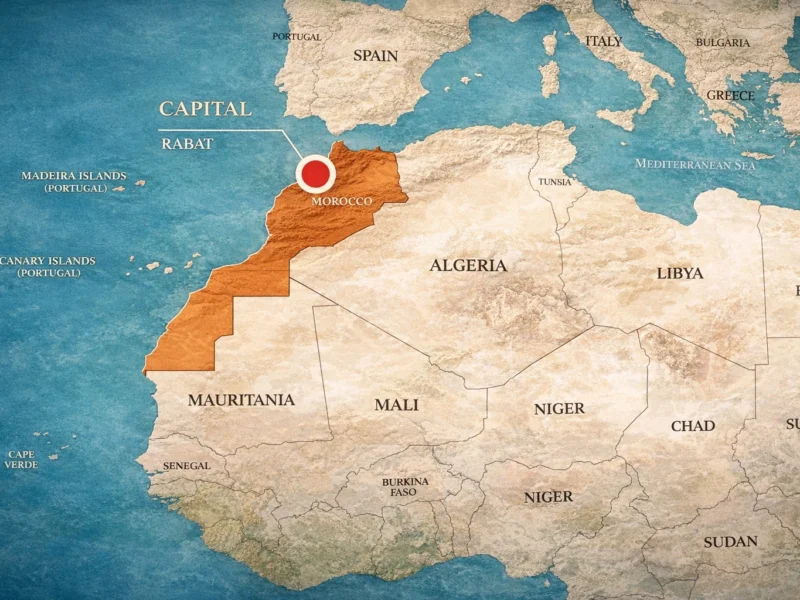
Morocco country occupies the northwestern corner of Africa — bordered by the Atlantic Ocean to the west, the Mediterranean Sea to the north, Algeria to the east, and Mauritania to the south — a geographic position of extraordinary strategic significance that has shaped the kingdom’s history, culture, and character throughout its more than 2,000 years of continuous civilization. Morocco country is the only African nation with both Atlantic and Mediterranean coastlines, and the only country in the world where a traveller can ski in the morning, surf in the afternoon, and sleep under Saharan stars the same evening.
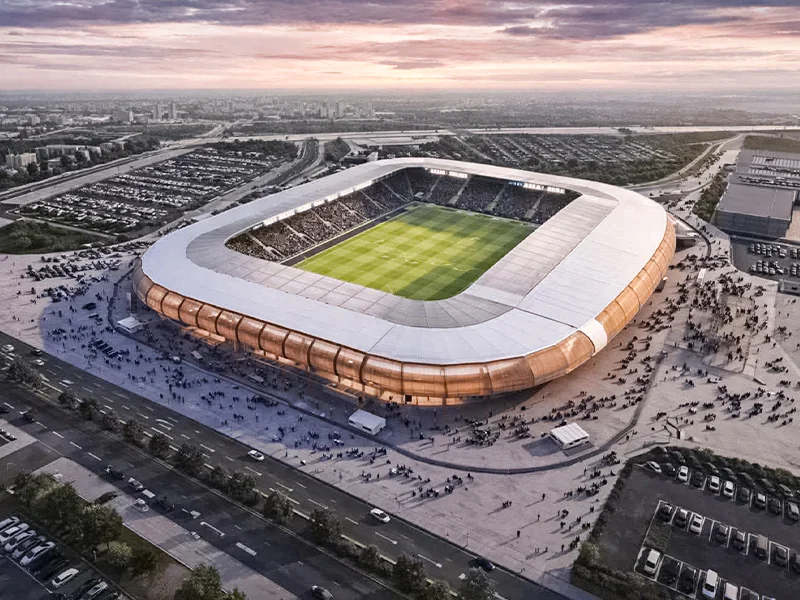
In 2026, Morocco country is more internationally visible and more visitor-ready than at any point in its modern history. The kingdom welcomed a record 17 million international tourists in 2024 — and Morocco’s preparations for co-hosting the 2030 FIFA World Cup with Spain and Portugal are driving the most significant infrastructure investment the country has seen in a generation. New motorways, expanded airports, restored heritage sites, and upgraded accommodation across every price category are making the Morocco country travel experience more accessible and more rewarding than ever before.
This guide covers every essential dimension of Morocco country — its geography, history, people, cities, coasts, economy, food, and practical travel information — providing the comprehensive overview that every visitor needs to understand and appreciate this extraordinary kingdom fully before and during their visit.
Before exploring Morocco country’s specific destinations and experiences, get the complete Morocco tourism picture by reading our comprehensive Morocco tourism guide — the most thorough overview of what the kingdom has to offer across every region.
Morocco Country: Geography and Landscapes
Morocco country’s geography is one of its most immediately remarkable qualities — a territory of approximately 710,000 km² (including the Western Sahara) that encompasses an extraordinary range of landscapes within distances that make meaningful multi-environment travel genuinely possible within a single trip.
The Atlas Mountain System
The dominant geographic feature of Morocco country is the Atlas Mountain system — a series of mountain ranges that run northeast to southwest across the country’s interior, dividing the Atlantic coastal plain and the northern Mediterranean coast from the pre-Saharan steppes and the Saharan desert to the south.
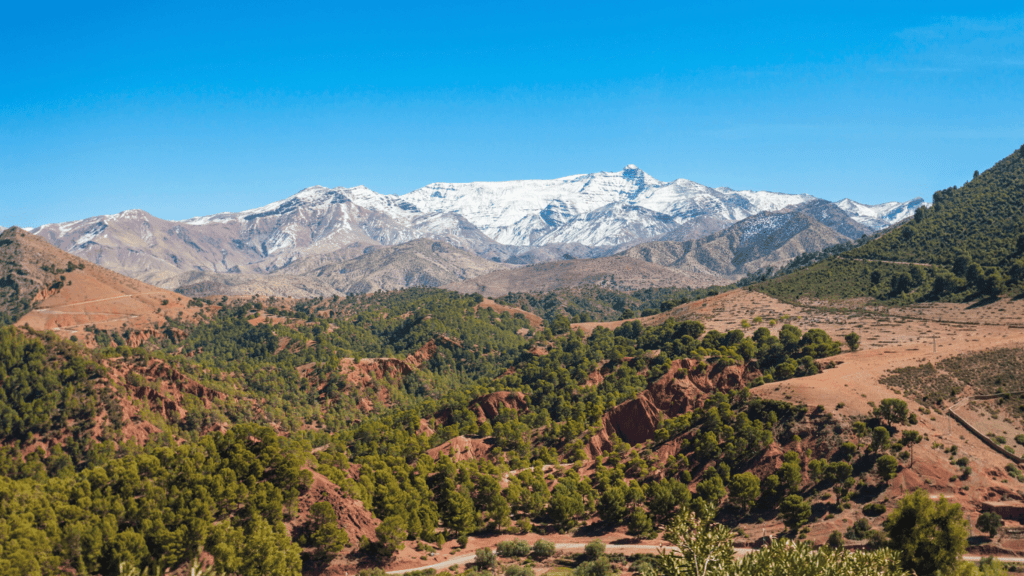
The High Atlas is the most dramatic component — rising to 4,167 metres at Jebel Toubkal, the highest peak in North Africa, and maintaining significant snowfall from November through April. The Middle Atlas — northeast of Marrakech — is home to cedar forests, Barbary apes, and mountain lakes of extraordinary beauty. The Anti-Atlas — extending southwest toward Agadir and the southern Atlantic coast — is a lower but equally dramatic range of rust-red rock and deep gorges that frames the transition from Morocco country’s Atlantic coast to its pre-Saharan landscape.
The Atlantic Coastal Plain
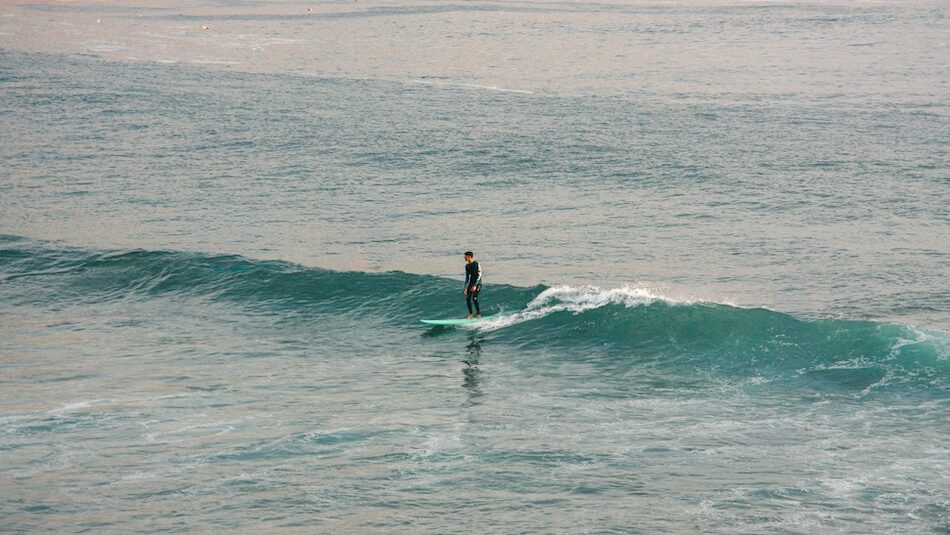
Morocco country’s Atlantic coast extends approximately 3,500 km from Tangier in the north to Dakhla in the far south — one of the longest Atlantic coastlines of any African nation and the source of the consistent swell and wind energy that has made Morocco country one of the world’s premier surf and wind-sport destinations. The northern Atlantic coast — from Tangier to Essaouira — features dramatic cliff and cove scenery, ancient fishing communities, and the argan forest of the Haha region. The southern Atlantic coast — from Agadir toward Dakhla — grows progressively more arid and more dramatically beautiful as it approaches the Saharan climate zone.
The Sahara Desert
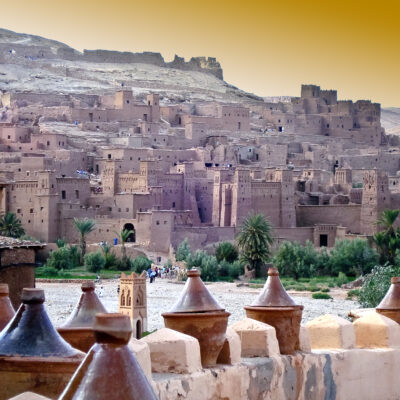
Morocco country’s portion of the Sahara — concentrated in the southeastern regions around Merzouga, M’Hamid, and Zagora — includes the Erg Chebbi dune fields whose 150-metre orange sand walls are among the most dramatic and most photographed Saharan landscapes available at any accessible location in North Africa. The Draa Valley — extending south from Ouarzazate through 200 km of date palm oases and ancient kasbahs — is the most scenically extraordinary transition zone between the Atlas Mountains and the full Saharan desert.
The Mediterranean Coast and Rif Mountains
Morocco country’s Mediterranean coast — from the Strait of Gibraltar near Tangier east to the Algerian border — is shorter, more sheltered, and more influenced by European proximity than the Atlantic coast. The Rif Mountains that back the Mediterranean coast are home to Chefchaouen — the extraordinary blue city — and a cultural tradition of Berber mountain independence that has shaped the northern character of Morocco country throughout its history.
For the finest road trip resource connecting all of Morocco country’s geographic landscapes into coherent travel circuits, read our Morocco road trip guide.
Morocco country geography Atlas Mountains Sahara Atlantic coast Mediterranean landscape
Morocco Country: History and Cultural Heritage
Morocco country’s history is one of the longest, most continuous, and most culturally layered of any nation in Africa — a 2,500-year narrative of Berber kingdoms, Phoenician trading posts, Roman provinces, Islamic dynasties, and European imperial competition that has produced an architectural and cultural heritage of extraordinary richness and diversity.
The Amazigh (Berber) Foundation
Morocco country’s oldest and deepest cultural layer is Amazigh — the indigenous Berber civilization that has inhabited the territory for at least 10,000 years and whose descendants — the Amazigh people — remain the country’s largest ethnic group and the primary cultural influence on Morocco country’s rural and mountain communities. The Amazigh language (Tamazight), traditions, crafts, music, and agricultural knowledge survive with remarkable vitality in the Atlas Mountains, the Haha coast between Essaouira and Agadir, and the Saharan southern regions — representing one of North Africa’s most significant living cultural heritages.
The coastal Haha Berber communities around Imsouane and the surrounding Atlantic coast preserve an Amazigh maritime and argan forest culture that is among the most distinctive and most authentic expressions of Morocco country’s indigenous heritage available to any visitor. For a complete guide to this living culture, read our dedicated article on the culture and hidden gems of Imsouane Morocco.
The Islamic Golden Age and Imperial Dynasties
Morocco country’s imperial history — from the Idrisid dynasty of the 8th century through the Almoravid, Almohad, Marinid, Saadian, and Alaouite dynasties that followed — produced the extraordinary architectural heritage of the four imperial cities. Fès — founded in 789 AD — was the cultural and intellectual capital of medieval Islamic North Africa, home to the Al-Qarawiyyin University (widely recognized as the world’s oldest continuously operating university) and a tradition of Islamic learning that attracted scholars from across the Muslim world. Marrakech, Meknès, and Rabat each served as imperial capitals at different periods, accumulating the palaces, mosques, madrasas, and urban infrastructure that make them among the finest surviving examples of Islamic and North African urban heritage anywhere in the world.
European Influence and the French Protectorate
Morocco country’s 20th-century history was shaped by the French and Spanish protectorates established in 1912 — a period of European colonial administration that modernized Morocco’s infrastructure, introduced French as a language of government and commerce, and created the distinctive new city (ville nouvelle) neighborhoods adjacent to the ancient medinas of Marrakech, Fès, Casablanca, and Rabat. Morocco country regained full independence in 1956 under King Mohammed V — a peaceful transition that preserved the Alaouite monarchy and established the constitutional framework under which the kingdom is governed today.
Contemporary Morocco Country
Morocco country today is a constitutional monarchy under King Mohammed VI — a modernizing and internationally engaged leader whose reign since 1999 has driven significant economic development, social reform, and international tourism investment. The kingdom’s preparations for the 2030 FIFA World Cup — co-hosted with Spain and Portugal — represent the most visible expression of Morocco country’s contemporary ambition and international confidence.
Morocco Country: People, Language and Religion
Understanding the people, language, and religious culture of Morocco country is among the most enriching and most practically useful preparations any visitor can make before arrival.
The Moroccan People
Morocco country’s population of approximately 38 million (2026) is predominantly Amazigh (Berber) in ethnic origin, with significant Arab cultural influence from the Islamic expansion of the 7th and 8th centuries and smaller Sahrawi, sub-Saharan African, and European communities. The Moroccan people are widely regarded as among the most hospitable and most genuinely welcoming in North Africa — a cultural value of hospitality (in Arabic, diyafa; in Tachelhit Berber, tawada) that operates independently of commercial tourism and creates the quality of authentic human warmth that consistent makes Morocco country one of the world’s highest-rated travel destinations for visitor satisfaction.
Languages of Morocco Country
Morocco country is functionally multilingual — a reflection of its layered history and its position at the crossroads of Berber, Arab, European, and sub-Saharan African cultural influence.
Arabic and Darija (Moroccan Arabic) are the primary languages of daily communication in Morocco country’s cities and towns. Darija — a distinctively Moroccan Arabic dialect incorporating significant Berber, French, and Spanish vocabulary — is the mother tongue of most urban Moroccans and the primary language of commerce and social interaction in the major cities.
Tamazight (Berber) — in its three main dialect forms of Tachelhit (southern), Tamazight (central Atlas), and Tarifit (northern Rif) — is the first language of Morocco country’s significant rural Amazigh communities. Tachelhit is the dominant Berber dialect of the southern Atlantic coast region — including the communities of Essaouira, Imsouane, Agadir, and the Haha region — where visitors who learn even basic Tachelhit greetings (“Azul” for hello, “Tanmirt” for thank you) are received with exceptional warmth.
French is widely spoken in Morocco country’s cities, in professional and commercial contexts, and throughout the formal tourism industry. Spanish is spoken in the northern regions historically associated with the Spanish protectorate — Tangier, Tetouan, and the Rif.
Islam in Morocco Country
Morocco country is a predominantly Sunni Muslim nation — Islam was introduced to the territory in the 7th century and has shaped Moroccan culture, law, architecture, social organization, and daily life comprehensively for over 1,300 years. The five daily prayers, the Friday Jumu’ah prayer, the annual Ramadan fast, and the celebration of Eid al-Kebir and Eid al-Fitr structure the rhythms of daily and annual life throughout Morocco country in ways that visitors who understand and respect these rhythms experience the country far more richly than those who do not.
For practical guidance on respecting Morocco country’s Islamic culture as a visitor, read our Morocco travel requirements guide which covers cultural etiquette alongside entry documentation.
Morocco Country: The Imperial Cities
Morocco country’s four imperial cities — Marrakech, Fès, Meknès, and Rabat — are the historical and architectural heart of the kingdom and the destinations that anchor most Morocco country travel itineraries for first-time visitors.
Marrakech
Marrakech is Morocco country’s most internationally famous city and the entry point for the majority of budget airline visitors from Europe. The UNESCO-listed medina, the legendary Djemaa el-Fna square, the Majorelle Garden, the Bahia Palace, and the Ben Youssef Madrasa make Marrakech one of the world’s great urban travel experiences. For a complete guide, read our Marrakech Morocco guide.
Fès
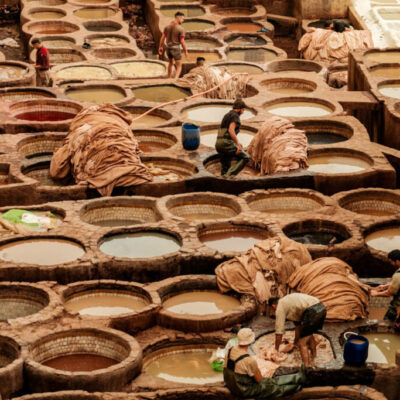
Fès el-Bali — the world’s largest car-free urban area — is Morocco country’s most intellectually and culturally profound city destination. The 9,000-alley medina, the Al-Qarawiyyin University, the Chouara Tannery, and the Bou Inania Madrasa create an experience of medieval Islamic urban civilization unmatched anywhere else in North Africa.
Chefchaouen, Meknès, and Rabat
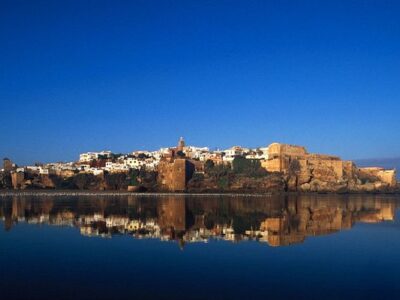
The blue city of Chefchaouen, the monumental imperial city of Meknès, and Morocco country’s elegant modern capital Rabat complete the imperial and historic city circuit that gives the kingdom its UNESCO-listed urban heritage framework. For a complete guide to all of Morocco country’s finest cities, read our must-visit cities in Morocco guide.
Morocco Country: The Atlantic and Mediterranean Coasts
Morocco country’s coastlines — particularly the Atlantic seaboard — are among the country’s most diverse and most rewarding travel environments, encompassing world-class surf destinations, UNESCO-listed walled cities, ancient fishing communities, and some of the most dramatically beautiful coastal scenery in Africa.
Essaouira — The Wind City
Essaouira is Morocco country’s most distinctive Atlantic coastal city — a UNESCO-listed walled medina of blue-and-white buildings, working fishing port, cannon-lined Atlantic ramparts, and extraordinary Gnawa music culture that creates one of the most atmospherically rich and most authentically Moroccan coastal experiences available anywhere in the kingdom. For everything about Essaouira, read our comprehensive Essaouira Morocco guide and our complete Essaouira what to do guide.
Imsouane — Morocco Country’s Atlantic Hidden Gem
Imsouane is the finest and most authentic destination on Morocco country’s southern Atlantic coast — a Berber fishing village of extraordinary natural beauty whose legendary right-hand surf wave, harbor fish grill, ancient argan forest, and genuine community warmth create an experience that represents Morocco country at its most elemental and its most rewarding. In 2026, Imsouane is the Morocco country destination whose growing international recognition has not yet eroded the authentic Berber community character that makes it genuinely special.
For everything you need to know about Imsouane, read our comprehensive Imsouane bay guide. For the best seasonal timing for visiting this extraordinary destination, read our dedicated best time to visit Imsouane guide.
Agadir and the Surf Coast
Agadir is Morocco country’s premier beach resort city — a modern Atlantic destination with Morocco’s finest sandy bay, excellent infrastructure, and proximity to the extraordinary surf coast north toward Taghazout and Imsouane. For investment-focused visitors to Morocco country’s Atlantic coast, our guides to buying land in Agadir and buying property in Marrakech provide comprehensive market analysis.
Morocco country Atlantic Mediterranean coast Essaouira Imsouane Agadir surf 2026
Morocco Country: Economy, Tourism and Development
Morocco country’s economy is one of the most diversified and most stable in Africa — a mix of agriculture, phosphate mining, manufacturing, services, and tourism that has produced consistent growth and positioned the kingdom as one of the continent’s most attractive investment destinations.
Tourism as an Economic Pillar
Tourism is one of Morocco country’s most important economic sectors — generating approximately 7–8% of GDP and employing over half a million people directly across the kingdom’s hotels, restaurants, transport, craft, and guiding industries. The record 17 million visitors in 2024 represented a new high point for Morocco country’s tourism economy — and the projections for 2026 and beyond are more optimistic still, underpinned by the 2030 FIFA World Cup preparations that are driving unprecedented infrastructure investment across every region.
Morocco country’s Atlantic coast — from Essaouira through Imsouane and Taghazout to Agadir — has emerged as one of the kingdom’s fastest-growing tourism corridors, driven by the global surf tourism boom, growing European lifestyle buyer demand, and the authentic Berber coastal culture that makes this stretch of Atlantic coast genuinely distinctive from any comparable destination in the Mediterranean world.
The 2030 FIFA World Cup Effect
Morocco country’s co-hosting of the 2030 FIFA World Cup with Spain and Portugal represents the most significant international sports event in the kingdom’s history and the most powerful single driver of infrastructure investment and international visibility in the current development cycle. New and upgraded stadia in Casablanca, Marrakech, Agadir, and Rabat. Expanded airport capacity across all major Moroccan airports. Improved road and rail connections between major cities. Enhanced accommodation capacity across all price categories. These investments are creating a Morocco country tourism infrastructure of genuinely international standard that will benefit visitors for decades beyond the tournament itself.
Property Investment in Morocco Country
Morocco country’s combination of political stability, welcoming foreign ownership framework, growing tourism infrastructure, and still-accessible property prices has made it one of North Africa’s most attractive real estate investment destinations for European and international buyers. For comprehensive guidance on property investment across Morocco country’s finest destinations, read our guides to buying land in Imsouane, buying land in Taghazout, and buying land in Agadir.
Morocco Country: Food and Culinary Traditions
Morocco country’s culinary culture is one of the kingdom’s greatest and most universally accessible pleasures — a cuisine of extraordinary complexity, historical depth, and democratic affordability that reflects the country’s geographic, cultural, and agricultural diversity in every dish.
The Pillars of Morocco Country Cuisine
Tagine — the slow-cooked stew of meat, vegetables, and aromatic spices prepared in the conical earthenware pot that gives it its name — is the defining dish of Morocco country cuisine. The variety of tagine preparations across the kingdom’s different regions — chicken with preserved lemon and olives in Marrakech, lamb with prunes and almonds in Fès, fish with chermoula on the Atlantic coast — reflects the geographic diversity of Morocco country’s ingredients and culinary traditions.
Couscous — the national dish of Morocco country — is traditionally prepared and eaten on Fridays across the kingdom, topped with seven vegetables, slow-cooked meat, and a rich broth that transforms simple semolina into one of the world’s great comfort foods. Pastilla — the extraordinary flaky pastry filled with pigeon and almonds, spiced with cinnamon and dusted with powdered sugar — is Morocco country’s most sophisticated and most distinctively Moroccan culinary creation.
Atlantic Coast Seafood
Morocco country’s Atlantic coast delivers its finest culinary expression at the harbor fish grills of Essaouira, Agadir, and Imsouane — where fresh sardines, sea bream, and mackerel caught that morning are grilled over charcoal and served with khobz bread and preserved lemon for $2–$5. This elemental seafood culture — connecting Morocco country’s fishing communities directly to the table without intermediary — represents the kingdom’s culinary identity at its most honest and its most delicious.
For a complete guide to food experiences across Morocco country’s Atlantic coast, read our Imsouane budget travel tips guide and our Morocco travel cost and budget guide.
Argan Oil — Morocco Country’s Liquid Gold
Morocco country is the only place on earth where argan trees grow naturally — and the argan oil produced from their nuts is one of the kingdom’s most prized culinary and cosmetic products. The Arganeraie Biosphere Reserve — the ancient argan forest that covers the hills and plains between Essaouira and Agadir — is where this extraordinary oil is produced by Berber women’s cooperatives using traditional stone mills and hand-cracking techniques unchanged for centuries. Amlou — argan oil mixed with toasted almonds and honey — is the most distinctively regional food of Morocco country’s southern Atlantic coast and one of the flavors most consistently recalled by visitors long after they have returned home.
Morocco Country: Travel Essentials
Getting to Morocco Country
Morocco country is served by excellent air connections from Europe — budget airlines including Ryanair, easyJet, Transavia, and Vueling operate direct routes from London, Paris, Amsterdam, Madrid, Brussels, and dozens of other European cities to Marrakech, Agadir, Casablanca, Fès, Tangier, and Essaouira. Royal Air Maroc operates long-haul connections from New York, Washington, Montreal, and major African cities to Casablanca.
Ferry connections from Spain (Algeciras and Tarifa to Tangier) provide an alternative entry point for visitors traveling overland from Europe.
Morocco Country Entry Requirements
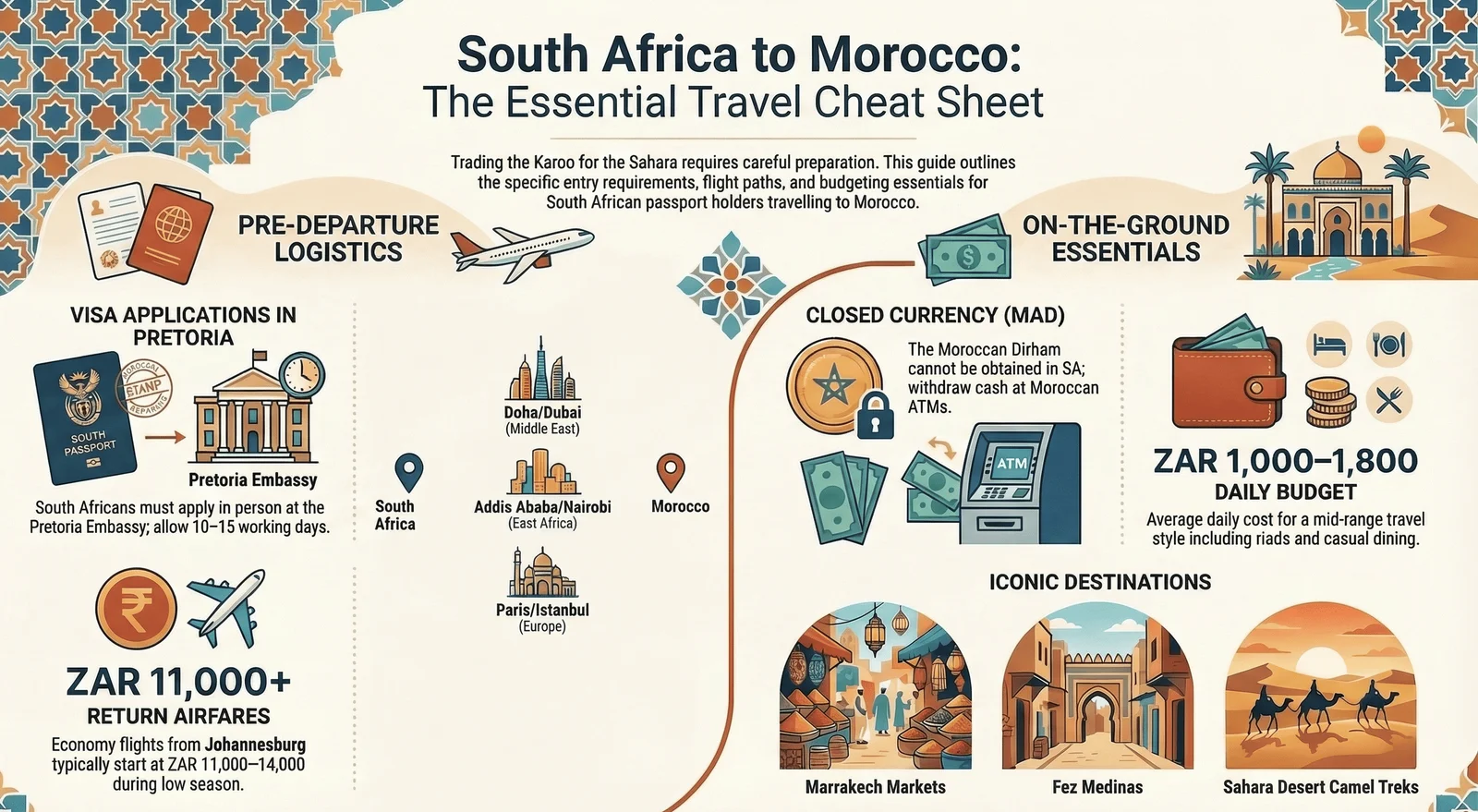
Most Western European, North American, and Australian visitors can enter Morocco country without a visa for stays of up to 90 days — requiring only a valid passport with at least six months of remaining validity. For a complete guide to Morocco country entry requirements, read our dedicated Morocco travel requirements guide.
Getting Around Morocco Country
The ONCF national railway connects Morocco country’s major imperial cities — Casablanca, Rabat, Meknès, Fès, and Marrakech — with comfortable, affordable, and reliable train services. The Al Boraq high-speed train connects Casablanca to Tangier in just over two hours. CTM and Supratours long-distance buses serve destinations not covered by rail. Car hire delivers the greatest flexibility — particularly for the Atlantic coast, mountain passes, and Saharan routes — and is strongly recommended for any Morocco country itinerary that includes more than two or three destinations.
Morocco Country Budget Planning
Morocco country offers extraordinary value at every budget level. Budget travel: $30–$40 per day. Mid-range travel: $60–$100 per day. Luxury travel: $200–$400 per day. For a complete breakdown of Morocco country costs across every category, read our comprehensive Morocco travel cost and budget guide.
Best Time to Visit Morocco Country
Spring (March–May) and autumn (September–November) are the finest overall seasons for Morocco country — comfortable temperatures across all regions, excellent surf on the Atlantic coast, and the country at its most balanced and most authentic. October is widely regarded as the single best month. For a complete seasonal guide, read our best time to visit Morocco guide.
Morocco Country: Why Visit in 2026
Morocco country in 2026 offers a uniquely compelling combination of reasons to visit — both timeless and time-specific — that make the coming year one of the finest moments in the kingdom’s modern tourism history to make the journey.
The Timeless Reasons
Morocco country has always offered — and continues to offer in 2026 — the timeless combination of extraordinary geographic diversity, 1,000-year-old medina culture, Saharan adventure, Atlantic surf, Berber mountain hospitality, exceptional food, world-class music, and some of the most authentic and most generously offered human warmth available at any destination on the African continent. These qualities are Morocco country’s permanent gift to every visitor — unchanged by seasons, infrastructure cycles, or sporting events.
The 2026-Specific Reasons
Morocco country in 2026 sits in a particularly compelling position in its development cycle — benefiting from the infrastructure investment and international visibility of World Cup preparation without yet having reached the saturation point that transforms genuine travel destinations into managed tourist experiences. The finest destinations on Morocco country’s Atlantic coast — particularly Imsouane, whose authentic Berber village character remains stubbornly and beautifully intact despite growing international recognition — are at a historic inflection point where the combination of accessibility, authenticity, and still-accessible prices creates a travel opportunity that will not remain available indefinitely.
For a full understanding of why Imsouane specifically represents Morocco country’s most compelling current travel opportunity, read our guide to reasons to visit Imsouane and our article on why Imsouane is the best surf town in Morocco.
Morocco Country’s Things to Do
For the most comprehensive resource covering everything Morocco country has to offer across every destination, experience type, and activity category, read our complete Morocco things to do guide and our things to do in Morocco guide.
External resource: Official Morocco Tourism — Kingdom Overview
External resource: UNESCO World Heritage Sites in Morocco Country
External resource: Morocco Country Travel Safety — UK Foreign Office
Morocco country why visit 2026 World Cup infrastructure authenticity Atlantic coast
Morocco Country — One of the World’s Great Kingdoms
Morocco country travel essentials getting there transport budget entry requirements
Morocco country in 2026 is one of the world’s great travel kingdoms — a nation of such geographic, historical, cultural, culinary, and experiential richness that it consistently delivers more than any visitor expects and generates the irresistible desire to return more completely than almost any other destination on earth.
From the 9th-century alleyways of Fès el-Bali to the 150-metre dunes of Erg Chebbi. From the blue streets of Chefchaouen to the cannon-lined Atlantic ramparts of Essaouira. From the summit of Jebel Toubkal to the harbor fish grill at Imsouane. From the extraordinary food of Djemaa el-Fna to the argan forest dawn walk above the Atlantic coast. Morocco country holds all of this — and more — within a single compact, accessible, and extraordinarily generous kingdom.
Come to Morocco country with time, with curiosity, and with genuine openness to being transformed by what is genuinely one of the finest travel destinations available to any international visitor in 2026.
Have questions about Morocco country or planning your perfect Morocco journey? Leave a comment below or explore our full collection of guides — including our Morocco tourism guide, Morocco road trip guide, best time to visit Morocco, Morocco travel cost guide, Morocco travel requirements, Morocco things to do guide, Marrakech Morocco guide, must-visit cities in Morocco, Essaouira Morocco guide, Essaouira what to do, Imsouane bay guide, best time to visit Imsouane, culture and hidden gems of Imsouane, Imsouane surfing paradise, and our complete Imsouane budget travel tips guide — for everything you need to experience Morocco country to its absolute fullest in 2026.
Comments