 By
By
Morocco travel requirements entry guide passport visa documentation 2026
Table of Contents
- Morocco Travel Requirements: Overview
- Morocco Travel Requirements: Passport Rules
- Morocco Travel Requirements: Visa Information
- Morocco Travel Requirements: Health Documentation
- Morocco Travel Requirements: Customs and Import Rules
- Morocco Travel Requirements: Travel Insurance
- Morocco Travel Requirements: Entry by Air
- Morocco Travel Requirements: Entry by Land and Sea
- Morocco Travel Requirements: Safety and Registration
- Morocco Travel Requirements: Practical Pre-Travel Checklist
Introduction
Morocco travel requirements in 2026 are among the most straightforward of any North African destination for visitors from Western Europe, North America, and most other major tourist-origin countries — making Morocco one of the most accessible and most rewarding destinations available to international travellers seeking culture, Atlantic coastline, Saharan adventure, and some of the finest surf in the world.
Understanding Morocco travel requirements before departure is essential — not because the requirements are complex or restrictive, but because arriving at the border without the correct documentation, the correct passport validity, or a clear understanding of what Morocco’s customs regulations permit can transform an eagerly anticipated arrival into an unnecessary complication. A few hours of preparation before departure eliminates this risk entirely and allows you to step off the plane or ferry in Morocco with complete confidence.
In 2026, Morocco travel requirements reflect the country’s position as one of Africa’s most visitor-friendly and most internationally integrated destinations. The kingdom has been actively expanding its tourism infrastructure ahead of the 2030 FIFA World Cup, improving its border processing systems, and maintaining the welcoming entry framework that has made Morocco a consistent top-10 Africa travel destination for visitors from Europe, North America, and beyond.
This guide covers every aspect of Morocco travel requirements for 2026 — passport rules, visa requirements by nationality, health documentation, customs regulations, travel insurance requirements, entry procedures at air, land, and sea borders, and a complete pre-travel checklist that ensures every traveller arrives in Morocco fully prepared.
Before exploring the practicalities of Morocco travel requirements, get the complete picture of what Morocco has to offer across its extraordinary range of destinations — from the imperial cities to the Atlantic surf coast — by reading our complete guide to things to do in Morocco.
Morocco Travel Requirements: Overview
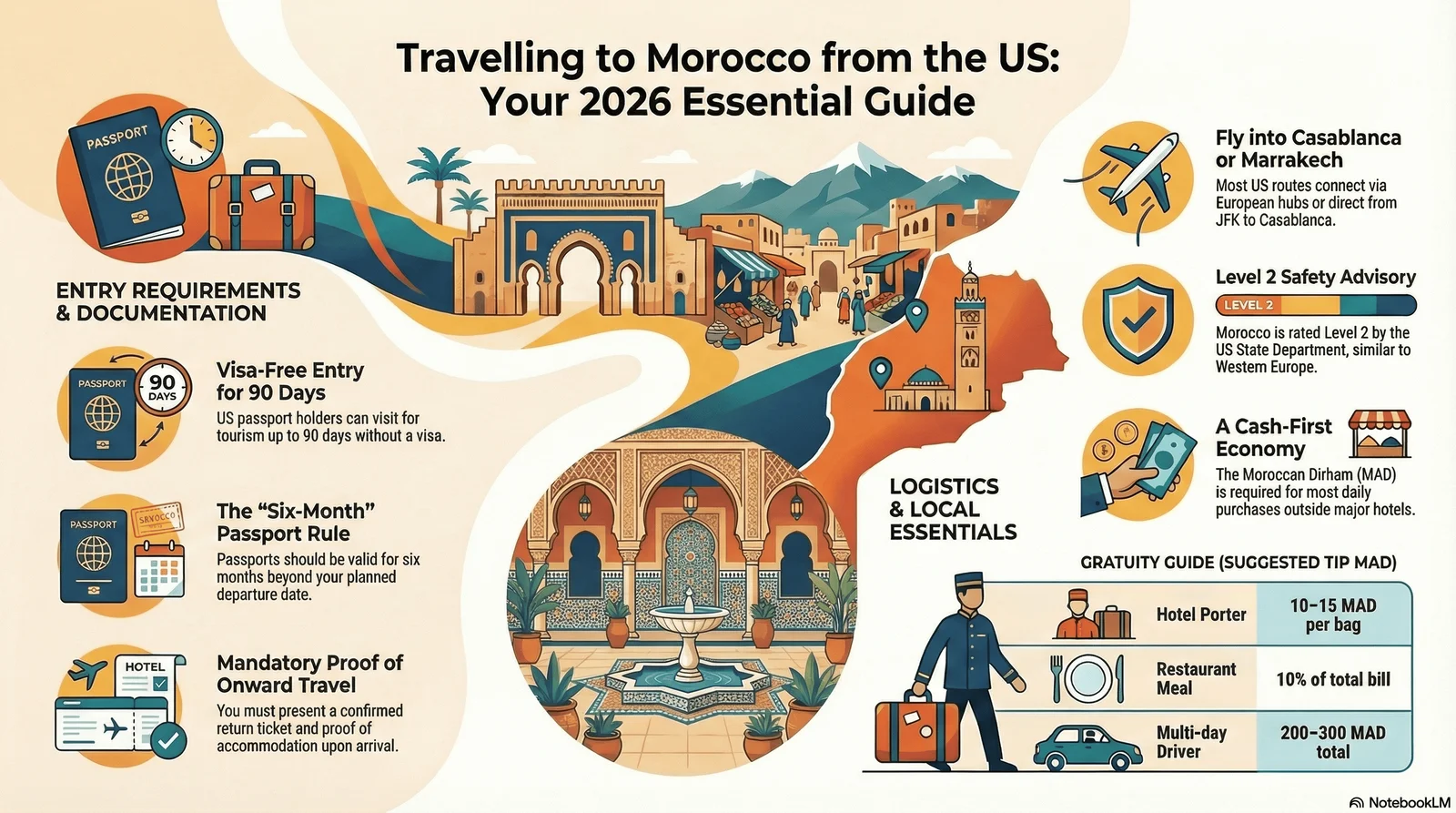
Morocco travel requirements in 2026 can be summarized in straightforward terms for the majority of international visitors — a valid passport with at least six months of remaining validity, no visa required for citizens of most Western countries for stays of up to 90 days, no mandatory health documentation for most nationalities, and compliance with Morocco’s customs regulations on currency, goods, and prohibited items.
Who Can Enter Morocco Visa-Free
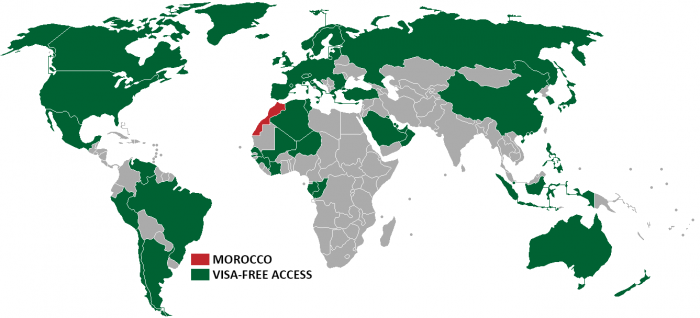
The vast majority of international visitors to Morocco — including all EU citizens, UK nationals, US citizens, Canadians, Australians, New Zealanders, and citizens of most Latin American, Asian, and Gulf countries — can enter Morocco without a visa for stays of up to 90 days. Morocco maintains one of the most open visa-free entry frameworks in Africa, reflecting its strategic commitment to international tourism as a pillar of the national economy.
Who Needs a Visa for Morocco
Citizens of certain countries — primarily from sub-Saharan Africa, South Asia, and parts of the Middle East — are required to obtain a visa before traveling to Morocco. The specific list changes periodically as Morocco updates its bilateral agreements. Always verify the current visa requirement for your specific nationality at the official Moroccan consulate or embassy in your country before booking travel.
Length of Stay
Morocco travel requirements permit most nationalities to stay for up to 90 days on a single visit. This 90-day period is calculated from the date of entry as stamped in your passport. Overstaying this period is a serious matter in Morocco — it can result in fines, difficulty exiting the country, and complications with future visa applications. Do not overstay your permitted period under any circumstances.
For travellers planning extended stays in Morocco — including those considering property investment along the Atlantic coast — our guides to buying land in Imsouane and buying land in Agadir cover the residency and legal framework relevant to long-term presence in the country.
Morocco Travel Requirements: Passport Rules
Passport validity is the most fundamental of all Morocco travel requirements — and the one that catches the most unprepared travellers at the border.
Minimum Passport Validity
Morocco requires that your passport be valid for at least six months beyond your intended date of entry. This means that if you plan to enter Morocco on June 1, 2026, your passport must be valid until at least December 1, 2026.
This six-month validity rule is strictly enforced at Moroccan ports of entry. Travellers whose passports expire within six months of their entry date will be refused entry — regardless of nationality, regardless of how long they plan to stay, and regardless of any other documentation they carry. Check your passport validity before booking flights, not after.
Passport Condition
Morocco travel requirements also require that your passport be in acceptable physical condition — undamaged, clearly readable, and with the biographical data page unobscured. Passports that are significantly water-damaged, have torn pages, or have a detached cover are frequently rejected at Moroccan border control. If your passport shows significant wear, obtain a replacement before traveling to Morocco.
Children’s Passports
Children traveling to Morocco must have their own valid passports — being listed on a parent’s passport is not accepted at Moroccan border control. Children’s passports must meet the same six-month validity requirement as adult passports.
Dual Nationals
Dual nationals — including Moroccans with foreign citizenship and foreigners with Moroccan citizenship — should be aware that Morocco does not formally recognize dual nationality. Moroccans traveling on a foreign passport may be treated as Moroccan nationals by Moroccan authorities in certain circumstances. Dual nationals should seek specific advice from the Moroccan consulate in their country of residence before traveling if they have any uncertainty about their status.
Morocco Travel Requirements: Visa Information
Visa requirements are the most nationality-specific component of Morocco travel requirements — and the area where the most variation exists between different travellers.
Visa-Free Entry — The Major Nationalities
The following nationalities can enter Morocco without a visa for stays of up to 90 days — confirming that Morocco travel requirements are genuinely minimal for the vast majority of international visitors:
All European Union member state citizens. United Kingdom nationals. United States citizens. Canadian citizens. Australian citizens. New Zealand citizens. Japanese citizens. South Korean citizens. Brazilian citizens. Argentine citizens. Most Gulf Cooperation Council citizens. Swiss citizens. Norwegian citizens. Icelandic citizens.
This list covers the overwhelming majority of Morocco’s international tourism market and reflects the country’s commitment to accessible international travel.
Nationalities Requiring a Visa
Citizens of countries not covered by Morocco’s visa-free framework must obtain a visa before traveling to Morocco. The visa application process is handled by Moroccan embassies and consulates in the applicant’s country of residence. Required documentation typically includes a valid passport, completed application form, passport photographs, proof of accommodation booking, return flight tickets, bank statements demonstrating sufficient funds, and travel insurance documentation.
Processing times for Moroccan visas vary by country and by consulate — allow a minimum of two to four weeks for standard processing, and check current processing times with your local Moroccan consulate well in advance of your intended travel date.
Visa on Arrival
Morocco does not currently offer a universal visa on arrival facility. Travelers who require a visa must obtain it before arrival — attempting to negotiate entry at the border without a valid visa is not a viable approach for nationalities that require one.
Extending Your Stay
Morocco travel requirements limit most visitors to 90 days. Extensions beyond this period require an application to Moroccan immigration authorities and are not routinely granted for tourism purposes. Travelers seeking to stay longer than 90 days — for work, study, or investment-related purposes — should contact the Moroccan consulate in their home country before departure to understand the correct visa category and extension process.
For travellers who are considering longer stays in Morocco related to property investment, read our guides to buying property in Marrakech and buying land in Taghazout for the legal and residency context relevant to property-owning foreign nationals in Morocco.
Morocco travel requirements visa passport nationality entry rules 2026
Morocco Travel Requirements: Health Documentation
Health documentation requirements are an important and frequently updated component of Morocco travel requirements — and the area most subject to change in the post-pandemic international travel landscape.
Current Health Entry Requirements
As of 2026, Morocco does not require proof of COVID-19 vaccination, negative COVID-19 tests, or any pandemic-specific health documentation for entry from most countries. Morocco removed its COVID-19 entry requirements following the global normalization of international travel post-pandemic and currently applies standard pre-pandemic health entry rules.
However, health entry requirements can change rapidly in response to international health developments. Always verify the current health entry requirements for Morocco at the official Moroccan government source or your country’s foreign ministry travel advice page immediately before travel — not weeks or months in advance.
Vaccinations — Recommended but Not Mandatory
No vaccinations are mandatory for entry to Morocco from most countries. However, several vaccinations are recommended by international health authorities for travelers to Morocco:
Hepatitis A — recommended for all travelers to Morocco regardless of destination or travel style. The hepatitis A virus is transmitted through contaminated food and water and is present throughout Morocco including in major cities.
Hepatitis B — recommended for travelers who may receive medical treatment, have tattoos or piercings, or have sexual contact during their visit.
Typhoid — recommended for travelers who will be eating at local restaurants, street food stalls, or in rural areas where food hygiene standards may be variable.
Rabies — recommended for travelers planning extended outdoor activities, trekking in the Atlas Mountains, or rural travel where contact with animals is possible.
Tetanus and routine vaccinations — ensure all standard vaccinations (MMR, DTP, polio) are up to date before traveling to Morocco.
Consult a travel medicine specialist or your GP at least six to eight weeks before travel for personalized vaccination advice based on your specific Morocco itinerary.
Water Safety
Tap water in Morocco’s major cities is technically treated but not recommended for drinking by international visitors whose digestive systems are not accustomed to local bacterial profiles. Bottled water is cheap and widely available throughout Morocco — budget 5–8 MAD ($0.50–$0.80) per 1.5-litre bottle from local épiceries. This is one of the Morocco travel requirements that is not a legal entry condition but is practically essential for avoiding the gastric disruption that affects many unprepared visitors.
For budget-conscious travelers managing water costs across an extended Morocco stay, our Imsouane budget travel tips guide and Morocco travel cost and budget guide cover practical cost management across every daily expense category.
Morocco Travel Requirements: Customs and Import Rules
Morocco’s customs regulations form an important component of Morocco travel requirements that every visitor should understand before departure — particularly regarding currency, alcohol, medications, and electronic devices.
Currency Regulations
Morocco operates currency controls on the Moroccan Dirham (MAD) — a currency that is not freely exchangeable outside Morocco. Key currency-related Morocco travel requirements include:
Travelers may bring up to 100,000 MAD ($10,000) equivalent in foreign currency into Morocco without declaration. Amounts above this threshold must be declared on arrival.
Foreign currency — euros, US dollars, British pounds, and other major currencies — can be exchanged at banks, exchange bureaus, and hotels throughout Morocco. Exchange rates at airport exchange desks are typically less favorable than those available at city-center banks.
Moroccan Dirhams cannot legally be exported from Morocco. Unspent Dirhams must be reconverted to foreign currency before departure — keep exchange receipts to facilitate reconversion.
Credit and debit cards are accepted at hotels, larger restaurants, and tourist-facing shops in major cities. However, cash is essential for street food, souks, medina guesthouses, smaller restaurants, and most transactions in villages and rural areas. Imsouane, for example, has no ATM within the village — cash must be obtained in Agadir or Essaouira before arrival.
Alcohol Import Rules
Morocco is a Muslim-majority country but permits the import of alcohol by non-Muslim visitors. Morocco travel requirements allow each traveler over 18 to bring up to one litre of spirits and one litre of wine into Morocco without duty. Quantities above these limits are subject to customs duty at Moroccan rates.
Attempting to bring alcohol into Morocco as gifts for Moroccan nationals is strongly discouraged and may attract scrutiny at customs.
Medication Rules
Travelers requiring prescription medication must carry it in original packaging with the prescription or doctor’s letter attached. Certain medications that are freely available or legally prescribed in some countries — including some controlled substances, opioids, and psychotropic medications — are subject to strict restrictions in Morocco. Research the Moroccan legal status of any prescription medication before departure and carry documentation accordingly.
Drone Regulations
Bringing a drone into Morocco requires advance authorization from the Moroccan Civil Aviation Authority. Travelers arriving with unregistered drones at Moroccan airports risk having them confiscated. Apply for authorization well in advance of travel if you intend to use a drone during your Morocco visit.
Prohibited Items
Morocco travel requirements prohibit the import of items including: narcotics and illegal drugs, weapons and ammunition without specific authorization, items considered culturally offensive under Moroccan law, and certain agricultural products. Morocco’s customs authorities conduct regular inspections at major entry points — declare all dutiable goods accurately and honestly.
Morocco Travel Requirements: Travel Insurance
Travel insurance is not a formal legal component of Morocco travel requirements for most nationalities — but it is one of the most practically important preparations any Morocco visitor can make.
Why Travel Insurance Is Essential for Morocco
Morocco’s major cities have adequate medical facilities for standard treatment — public hospitals and private clinics in Casablanca, Marrakech, Agadir, and Rabat can handle most medical situations competently. However, medical evacuation from remote areas — the High Atlas Mountains, the Sahara desert, or the more isolated stretches of the Atlantic coast — can be extremely expensive without insurance coverage. A helicopter evacuation from a mountain trekking accident or a serious road accident on the Tizi n’Tichka pass can generate medical bills of $10,000–$50,000 or more without appropriate coverage.
Travel insurance covering medical treatment, medical evacuation, trip cancellation, luggage loss, and personal liability is strongly recommended for all Morocco visits regardless of nationality, travel style, or duration of stay.
What Your Policy Should Cover
For travel to Morocco, ensure your travel insurance policy specifically covers emergency medical treatment in Morocco, medical evacuation to your home country or to the nearest appropriate medical facility, adventure activities if you plan to surf, trek, or participate in desert excursions, trip cancellation and interruption for any reason, and luggage and personal belongings including camera equipment and surf gear.
Surfing — a primary activity for many Atlantic coast visitors — is sometimes excluded from standard travel insurance policies as an adventure activity. If your Morocco itinerary includes surfing at Imsouane, Taghazout, Essaouira, or any other Atlantic break, verify that your policy explicitly covers surfing before departure.
For a complete understanding of Morocco’s Atlantic surf coast and the activities that require insurance consideration, read our guide to Imsouane surfing paradise and our guide to why Imsouane is the best surf town in Morocco.
Morocco travel requirements travel insurance health medical surfing adventure 2026
Morocco Travel Requirements: Entry by Air
The vast majority of international visitors to Morocco arrive by air — and understanding the air entry process makes the Morocco travel requirements experience significantly smoother.
Major Entry Airports
Morocco has several international airports serving different regions of the country. The choice of entry airport significantly affects how easily you can access your intended Morocco destinations.
Mohammed V International Airport, Casablanca — Morocco’s largest and most connected airport, serving the widest range of international routes including long-haul connections from North America, the Middle East, and sub-Saharan Africa. Best entry point for visitors heading to Casablanca, Rabat, Fès, Meknès, or the imperial cities circuit.
Marrakech Menara Airport — the second busiest airport and the primary entry point for budget airline flights from Europe. Served by Ryanair, easyJet, Transavia, Vueling, and others with direct flights from London, Paris, Amsterdam, Madrid, Brussels, and dozens of other European cities. Best entry point for Marrakech and the Atlas Mountains region.
Agadir Al Massira Airport — the primary entry point for the southern Atlantic coast. Served by Ryanair, easyJet, Transavia, and Vueling from major European cities. Best entry point for Agadir, Taghazout, Imsouane, and the Atlantic surf coast. For travellers planning to visit Imsouane, Agadir is the most convenient and frequently the most affordable entry airport.
Fès-Saïss Airport — serves Fès and the northern imperial cities region with direct European connections.
Tangier Ibn Battouta Airport — serves Tangier and northern Morocco with connections to European cities.
The Air Entry Process
Arriving in Morocco by air, passengers pass through the following sequence: aircraft disembarkation, passport control (where your passport is inspected and stamped), baggage collection, and customs declaration. The entire process at major Moroccan airports is typically completed within 30–60 minutes for flights from Europe.
At passport control, present your valid passport and any required entry documentation. Border officers may ask about the purpose and duration of your visit, your accommodation address in Morocco, and your return travel arrangements. These are standard questions — answer them clearly and honestly.
The embarkation card — a simple arrival form requesting your name, nationality, flight number, and Morocco address — must be completed before reaching passport control. Cards are distributed on the aircraft or available at the passport control queue. Complete yours carefully — the information on the card must match your passport exactly.
Morocco Travel Requirements: Entry by Land and Sea
Morocco travel requirements for land and sea entry follow the same fundamental framework as air entry — valid passport, appropriate visa if required, and compliance with customs regulations — but with some specific considerations for each entry route.
Entry by Ferry — Spain to Morocco
Ferry services connect mainland Spain (Algeciras, Tarifa) and the Spanish enclaves of Ceuta and Melilla with Morocco. This is the primary entry route for travelers arriving from Europe by road or combining a Morocco visit with a Spain road trip.
The Algeciras to Tangier ferry — operated by FRS, Balearia, and other carriers — is the most popular and most direct ferry route, with crossings taking approximately 35–90 minutes depending on the service. Passport control is conducted on arrival at the Moroccan port. The same passport validity and documentation requirements apply as for air entry.
The Ceuta and Melilla land border crossings — from Spanish sovereign territories into Morocco — are busy and can involve significant queuing, particularly at peak travel periods (summer weekends, Spanish school holidays). Allow substantial extra time for these border crossings.
Entry by Land — Algeria Border
The Algeria-Morocco land border has been closed since 1994 and remains closed in 2026. Morocco travel requirements do not currently permit land entry from Algeria. Travelers planning itineraries that include both Morocco and Algeria must make separate travel arrangements for each country — flying between them rather than crossing overland.
Entry by Land — Mauritania Border
The Morocco-Mauritania land border at Guerguerat in the Western Sahara is open and passable for travelers making the overland journey between Morocco and sub-Saharan Africa. This border crossing requires careful preparation — research current conditions, required documentation, and any security advisories for the Western Sahara region before attempting this crossing.
For Morocco road trip planning that helps contextualize the country’s geography and the routes between major destinations, read our Morocco road trip guide — the most comprehensive self-drive planning resource available for Morocco in 2026.
Morocco Travel Requirements: Safety and Registration
Understanding Morocco’s safety landscape and registration requirements is the final component of comprehensive Morocco travel requirements preparation.
General Safety
Morocco is one of Africa’s safest countries for international visitors. Violent crime targeting tourists is rare. The most common security concern for visitors — particularly in medina environments in Marrakech and Fès — is petty theft (pickpocketing in crowded areas) and persistent approaches from unofficial guides and touts. Standard urban safety precautions — keeping valuables secure, being aware of surroundings in crowded areas, and not displaying expensive jewelry or electronics — are sufficient for the vast majority of Morocco visits.
The Atlantic coast destinations covered extensively in our guides — Essaouira, Imsouane, Taghazout, and Agadir — are consistently rated among the safest and most welcoming environments in Morocco for international visitors. For everything you need to know about visiting Imsouane safely and respectfully, read our guide to the culture and hidden gems of Imsouane Morocco.
Border and Restricted Areas
Certain areas of Morocco — particularly border regions with Algeria and in the Western Sahara — are subject to security restrictions and travel advisories. Always check your government’s current travel advice for Morocco before departure, including any specific warnings about restricted or elevated-risk areas.
Registering with Your Embassy or Consulate
Most foreign governments encourage their citizens to register with the embassy or consulate in Morocco before or upon arrival — particularly for extended stays or travel to remote areas. Registration is not a formal Morocco travel requirement but provides access to emergency consular assistance and ensures your government can contact you in the event of a serious national emergency or natural disaster. UK travelers can register through the FCDO’s LOCATE service. US travelers can register through the Smart Traveler Enrollment Program (STEP).
Photography Restrictions
Photography of Moroccan military installations, government buildings, ports, and border areas is prohibited under Moroccan law. Photography of individuals — particularly women in traditional dress — should always be conducted with explicit permission. These are not formal Morocco travel requirements but are practical and cultural rules that every respectful visitor should follow.
External resource: UK Foreign Office Morocco Travel Advice
External resource: US State Department Morocco Travel Advisory
External resource: Official Morocco Tourism Entry Information
Morocco travel requirements safety registration embassy consulate advice 2026
Morocco Travel Requirements: Practical Pre-Travel Checklist
The most useful summary of Morocco travel requirements is a practical checklist that every traveller can complete before departure — ensuring nothing is overlooked and every aspect of entry preparation is covered.
Documents — Check Before You Book
Verify your passport validity — minimum six months beyond your entry date. If your passport expires within six months of your planned Morocco arrival, renew it before booking travel. Check the current visa requirement for your specific nationality at the Moroccan consulate website or your government’s travel advice page. If a visa is required, begin the application process immediately — allow four to six weeks for processing.
Make photocopies of your passport biographical page, travel insurance documents, accommodation bookings, and return flight tickets. Store one set in your luggage, carry one set separately, and email a set to yourself and a trusted contact at home.
Health — Prepare Six to Eight Weeks Before Departure
Consult a travel medicine specialist or your GP for personalized vaccination advice for Morocco. Consider hepatitis A, typhoid, and tetanus at minimum. Obtain any recommended vaccinations with sufficient time for full immunization before departure. If you take prescription medication, obtain sufficient supply for your entire Morocco stay plus a contingency week. Carry medication in original packaging with prescription documentation.
Purchase comprehensive travel insurance that explicitly covers Morocco, medical evacuation, and any adventure activities — including surfing if your itinerary includes the Atlantic coast. Never travel to Morocco without adequate travel insurance.
Money — Prepare Before Departure
Research the current MAD exchange rate and plan your cash budget for the Morocco trip. Notify your bank of your Morocco travel dates to prevent card transactions being blocked as suspicious. Bring a mix of cash (euros, US dollars, or British pounds are easiest to exchange) and at least two payment cards from different networks. Remember that destinations including Imsouane have no ATMs — cash must be obtained in advance from larger cities.
For complete cost planning across every aspect of a Morocco trip, read our Morocco travel cost and budget guide.
Connectivity — Set Up Before Departure
Purchase a local Moroccan SIM card on arrival at the airport — Maroc Telecom and Inwi are the two main operators with the best coverage across Morocco including the Atlantic coast. Download offline maps of your Morocco destinations before departure — Google Maps offline mode and Maps.me both work reliably in Morocco including in medina areas where GPS accuracy is variable.
Download the translation app of your choice with Arabic and French language packs for offline use — useful for medina navigation, menu reading, and basic communication in rural areas where English is uncommon.
Packing — Morocco-Specific Essentials
Pack modest clothing for medina and rural exploration — shoulders and knees covered away from beach and pool areas. A light windproof jacket is essential for the Atlantic coast at any time of year — particularly for Essaouira, Imsouane, and any rooftop dining. Comfortable walking shoes with good grip for medina cobblestones. High-factor sun protection — the Moroccan sun is intense year-round, particularly reflected off white medina walls and Atlantic sand. A small day pack for medina exploration — preferably one that zips securely to minimize pickpocketing risk.
For Atlantic coast and surf destination packing specifics, read our best time to visit Imsouane guide which covers seasonal packing requirements for the Atlantic coast in detail.
Before You Leave Home
Save your accommodation contacts in your phone — WhatsApp numbers for your riads and guesthouses, with offline access. Save the emergency number for your country’s embassy or consulate in Morocco. Save the nearest hospital address for each Morocco destination on your itinerary. Tell a trusted person at home your complete Morocco itinerary — where you are staying each night and how to contact you.
Morocco travel requirements checklist passport insurance money packing 2026
Morocco Travel Requirements Are Simple — Preparation Makes Them Seamless
Morocco travel requirements in 2026 are genuinely among the most accessible and most straightforward of any major international destination for visitors from Western Europe, North America, and most other major tourism-origin countries. A valid passport with six months of remaining validity, no visa for most nationalities, no mandatory health documentation for most visitors, and sensible compliance with customs regulations is all that stands between you and one of the world’s most extraordinary and most diverse travel destinations.
The preparation this guide describes — checking passport validity, verifying visa requirements, obtaining recommended vaccinations, purchasing comprehensive travel insurance, and completing the practical checklist above — takes a few hours at most. Against the backdrop of what Morocco offers — the imperial cities, the Sahara, the Atlas Mountains, the ancient argan forest, and the extraordinary Atlantic coast from Essaouira south through Imsouane to Agadir and Taghazout — a few hours of preparation is among the finest investments of time available to any international traveller in 2026.
Get your documents in order. Get your vaccinations done. Get your travel insurance in place. And get to Morocco.
Have questions about Morocco travel requirements or planning your Morocco journey? Leave a comment below or explore our full collection of guides — including our Morocco road trip guide, best time to visit Morocco, Morocco travel cost guide, things to do in Morocco, Marrakech Morocco guide, must-visit cities in Morocco, Imsouane bay guide, best time to visit Imsouane, Essaouira hotels guide, riad in Essaouira, from Marrakech to Essaouira, and our Imsouane budget travel tips — for everything you need to plan an extraordinary Morocco journey in 2026.

Comments